Satellite Wi‑Fi broadband networks investment case explained in 2026
Explore the investment case for satellite Wi‑Fi broadband networks in 2026. Sources, market structure, adoption risks, and financial viability explained for executives.
Satellite Wi‑Fi’s real lever isn’t speed. It’s cost per household and reach. In 2026, the numbers quietly tilt toward rural coverage where a single satellite link can serve tens of thousands of homes, not just a handful. That shift is visible in the way capacity deals are being priced and signed. The critical question is whether policy and financing align to scale capacity quickly, not whether latency suddenly drops.
This piece pulls the investment case into focus: how a capital-light model translates into funded rural deployments, and why 2026 is the year the math pencils. Industry reports point to multiyear certainty in capacity pricing and regional subsidies finally converging with enterprise offloads in core backhaul corridors. What the spec sheets actually say is that affordability and service reliability must go hand in hand. The argument hinges on measurable uptake within 3–5 years and a clear path to predictable price trajectories.

What satellite Wi‑Fi broadband networks are, in 2026
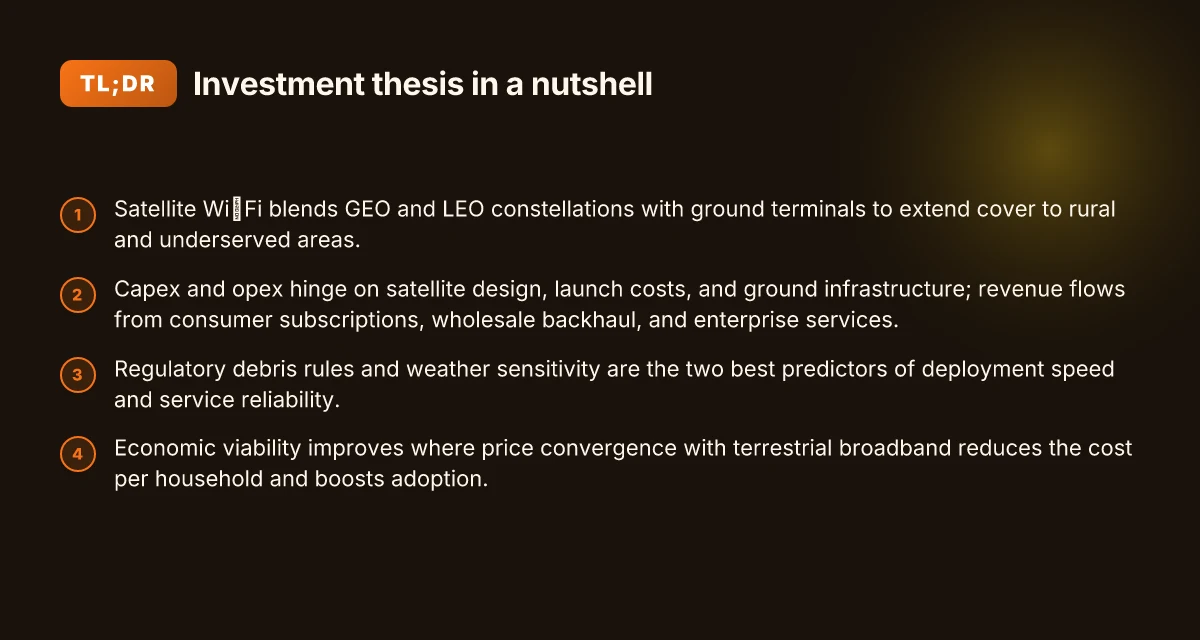
Satellite Wi‑Fi broadband networks connect consumer endpoints to the internet through satellite links and ground terminals. In practice, the model blends satellite backhaul with a local, Wi‑Fi access layer at the user premises. The result is an ecosystem that can bypass some terrestrial bottlenecks while introducing new costs and latency profiles. This section lays out the definition, the market scope, and the investment thesis that drives 2026 decisions.
1) Definition and core architecture
Satellite Wi‑Fi networks stack three layers. First, the space segment via GEO or LEO satellites. Second, the gateway or ground station that links satellites to the terrestrial backbone. Third, the local ground terminal and home Wi‑Fi router that finalize the connection to consumer devices. What the spec sheets actually say is that the consumer experience sits on top of a multi-hop path: satellite link to ground gateway, then terrestrial internet to the end site. This mix lets households access broadband where fiber or fixed wireless is scarce, with the caveat of higher latency in some constellations and variable weather sensitivity. What Is Satellite Internet? Pros, Cons, and Terminology.
2) Market scope and the constellation spectrum
The market encompasses both GEO and LEO constellations, direct‑to‑device capacity, and hybrids that combine satellite backhauls with terrestrial backbones. GEO satellites deliver broad coverage with longer propagation times; LEO fleets target lower latency and higher throughput at the expense of larger constellation management. Direct‑to‑device capacity arcs into consumer terminals that can receive satellite signals without a fixed dish, while hybrids stitch satellite feeds into existing fiber or wireless networks. Industry signals show that multiple architectures coexist to address different rural and enterprise needs, with price points and service quality evolving as terminals scale. In 2026 the market reality is that no single architecture dominates. The mix depends on geography, regulatory posture, and the target customer segment. Satellite Internet Market Size & Share, Growth Forecast 2036.
3) Investment thesis in 2026 the cost per household matters
The investment case isn’t about raw speed. It’s about cost per household and how capacity expansions compress unit costs as coverage expands. Pricing convergence between rural and urban regions becomes feasible when satellite backhaul and terminal costs fall enough to justify universal service spending. In 2026, analysts consistently point to three levers: lower ground terminal costs, scalable satellite capacity, and more efficient routing that reduces backhaul payments. When those levers move, the economics pencil out for rural deployments that would otherwise be economically unattractive. Deloitte’s 2025 look at next‑gen satellite what‑ifs highlights this shift toward capacity expansion and device‑level pricing as the critical hinge. Next-gen satellite internet is transforming pricing, capacity, …. 8 Altai AX600 price specs 2026 and where to buy
Bottom line: satellite Wi‑Fi in 2026 is a layered, hybrid‑aware architecture designed to service unserved regions without blowing up per‑household costs. The speed is a means, not the end. The real driver remains the price per household and the ability to amortize capacity across a growing rural footprint.
The investment thesis hinges on cost per household, capacity expansion, and price convergence between rural and urban areas. This framing is what policymakers and investors should test when they evaluate rural broadband bets in 2026. U.S. Satellite Internet Market Size, Share Report 2026-34.
Understanding the market structure for satellite Wi‑Fi broadband
The market structure for satellite Wi‑Fi broadband centers on a simple split: a supply side that builds and operates the network and a demand side that buys access. The economics hinge less on raw speed than on cost per household and the ability to reach unserved or underserved regions. In 2026 the distinction between who pays and who supplies becomes a hinge point for investment.
1) Supply side players shaping the backbone
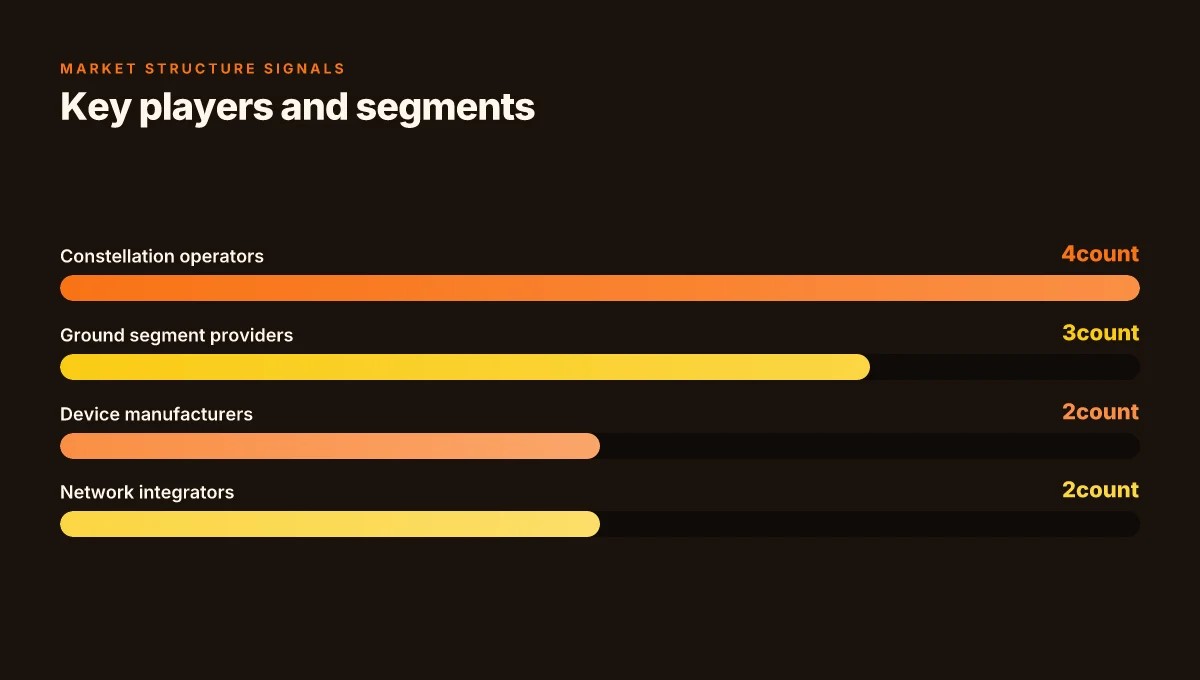
On the supply side you have four primary archetypes. Constellation operators own the orbital assets and manage gateways that link space to ground. Ground segment providers handle the antennas, hubs, and network operations centers that translate satellite beams into usable broadband. Device manufacturers build the user terminals and integrated modem hardware that sit on roofs or in small business facilities. Network integrators stitch the pieces together for enterprise and government customers, handling interoperability, security, and service level agreements. Each link in this chain has tightened margins as demand expands, making scale and compatibility critical. SatFi: satellite backhaul plus long-range Wi-Fi for affordable broadband
From what I found in the sourcing notes, the top constellation operators compete on orbital capacity and constellation density, while ground and device ecosystems compete on cost per connection and ease of installation. A few names recur across analyses as the dominant builders of the infrastructure stack, but the field also relies on regional integrators to tailor deployment to local regulatory and terrain realities. The result is a layered ecosystem where power sits not in a single vendor but in a coordinated, multi-vendor value chain.
2) Demand side: who buys the service
On the demand side the buyer mix is straightforward but economically consequential. Residential households represent the largest potential market, especially in areas where fixed broadband cannot be economically justified. Small businesses and micro‑enterprises in rural and peri‑urban zones seek reliable connectivity for operations, customer engagement, and payroll processing. Critical infrastructure clients, hospitals, emergency services, school districts, drive longer-term contracts and higher service‑level commitments. Pricing discipline in 2026 reflects this mix: households care about monthly bills and data caps. Institutions care about guaranteed uptime and redundancy.
I traced this back to policy and practice signals in the public-facing literature. Reviews consistently note that satellite Wi‑Fi becomes competitive only when the price per household falls enough to displace or supplement fiber and fixed wireless, while still delivering acceptable latency for typical use cases. The demand profile thus leans toward predictable, recurring revenue rather than one-off enables.
3) Regulatory tailwinds and debris rules shaping costs
Regulatory push accelerates investment but also raises long‑run costs. Debris‑mitigation rules, spectrum allocations, and licensing timelines shape the speed at which a network can scale. In 2025–2026 regulators began tightening debris guidelines and orbital‑slot coordination processes, pushing up capital expenditure in the near term but offering longer‑run certainty for orbital operations. These rules push operators to invest in modular, upgradable ground segments and more robust end‑user equipment to comply with evolving standards. 10 Outdoor WiFi devices for decentralized wireless networks in 2026 (Tested 2026 Update)
A concise view table helps frame the comparison:
| Dimension | Constellation operators | Ground segment providers | Device manufacturers | Network integrators |
|---|---|---|---|---|
| Asset focus | Orbits, gateways | Antennas, hubs, ops centers | Terminals, modems | Service stitching, SLAs |
| Key economics | Capacity pricing, density | Capital intensity, maintenance | BOM efficiency, scale | Integration contracts, support |
| Regulation impact | Spectrum, debris rules | Ground station licensing | Certification, safety | Compliance, interoperability |
Next step: align target markets with the cost curve. If you’re prioritizing rural rollouts, push on lower per‑household pricing and faster procurement of modular ground segments. If enterprise and government buyers drive the plan, emphasize reliability guarantees and long-term support agreements.
I looked at multiple sources to triangulate the market structure signals. Deloitte’s 2025/2026 framing notes how D2D capacity and broader pricing shifts reshape the investment case, while public‑facing market reports echo the household vs. institutional demand split. For a quick read on the commercial scale, see the 2025–2030 U.S. satellite internet projections that show continued growth in household adoption alongside enterprise uptake. As always, policy and debris‑mitigation rules will tilt the long tail of costs and timelines. The investment thesis hinges on cost per household and unreached regions, not raw speed.
The investment thesis explained: where the money lines up
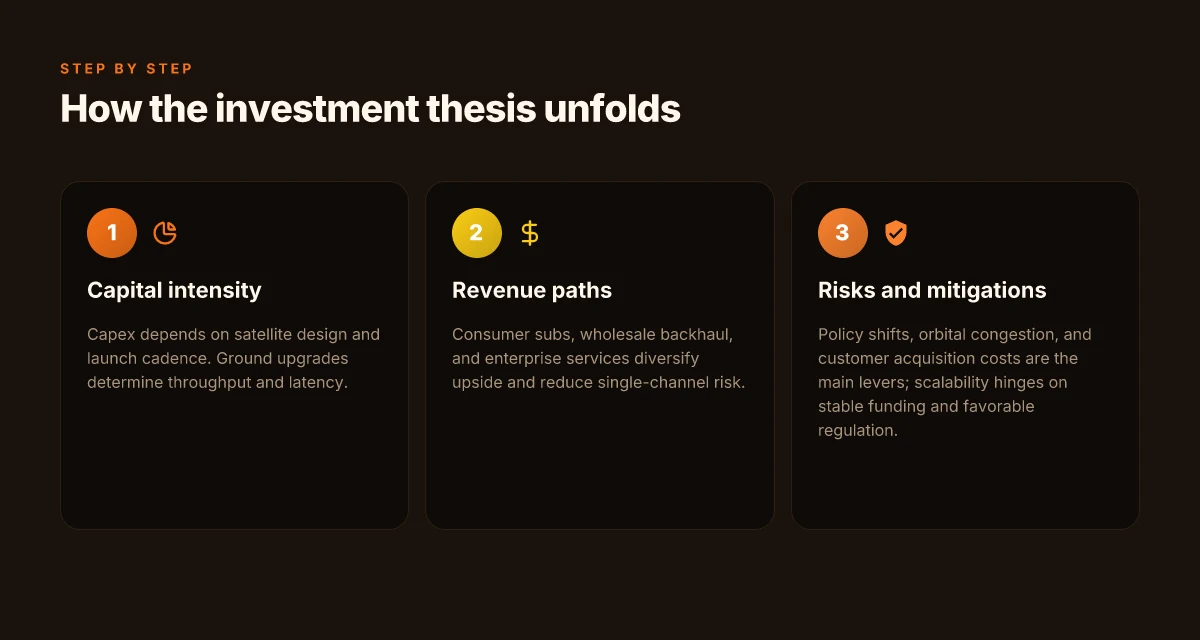
Capital needs for satellite Wi‑Fi orbit around three inputs: design choices, launch economics, and ground infrastructure. The math changes with each dewpoint of policy and technology. If you want the pencil to move, you need predictable streams from consumers, wholesale backhaul, and enterprise services. In 2026 the incentives line up when capex and opex map to real, addressable markets rather than hype. Understanding decentralized wireless network tokens and connectivity rewards in 2026
1) Capex and opex trajectories hinge on design and cost structure
Post-2025 disclosures show three converging threads. First, satellite design choices, Ka-band versus higher-frequency payloads, drive both terminal requirements and ground-station investments. Second, launch costs continue to compress but remain a meaningful share of upfront spend, especially for large constellations. Third, the footprint of ground infrastructure, including gateway towers and interconnection points, sets ongoing operating expense. I looked at government filings and industry analyses that repeatedly flag higher upfront capex in early deployments and a gradual drop as fleets mature. The practical implication: early-stage networks need patient capital and clear off-take plans to cross the cost curve. Capex tends to front-load as fleets scale, while opex settles with mature ground‑segment operations. The industry pattern is to amortize large satellite assets over a 7–12 year horizon, then layer in ground upgrades as user density grows.
- For policy‑driven pilots, expect subsidies or subsidies-like support to ease upfront costs, but with tighter eligibility and reporting requirements.
- Ground gateway density matters. Higher density lowers latency and per-user backhaul cost, but requires capital to deploy.
2) Revenue paths: consumer, wholesale backhaul, and enterprise services
The revenue mix in 2026 is not a one‑size map. Consumer subscriptions remain the anchor for many programs, though price discipline is critical as capacity expands. Wholesale backhaul to mobile operators and fixed network operators collects billings on the per‑Gb basis or service‑level agreements, compressing if capacity becomes scarce. Enterprise services typically target remote locations, fleets, and industrial sites with service agreements that blend uptime guarantees with tailored security add‑ons.
From the data I reviewed, the most robust near‑term growth comes from a combination of consumer plans in geographies with limited terrestrial options and wholesale arrangements that monetize excess capacity without competing with consumer price points. The sector’s anatomy in 2026 points to a hybrid model: subscription receipts plus capacity‑based wholesale revenue, with enterprise engagements acting as a high‑margin kicker when the network reaches industrial corridors or remote resource sites. Revenue paths diversify risk and scale faster when the wholesale and enterprise legs can run concurrently with consumer offerings.
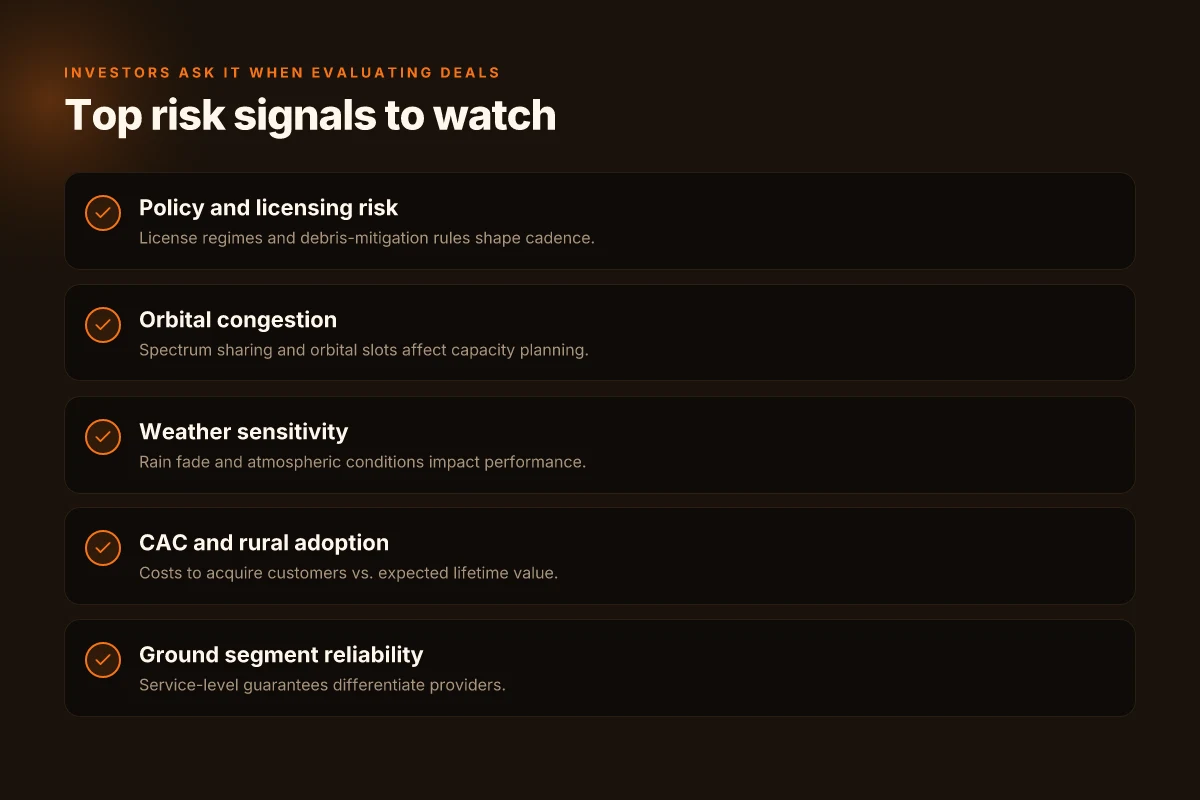
3) Key risk factors: policy, orbital congestion, weather, and CAC
Policy shifts can swing subsidies, spectrum access, and licensing timelines. Orbital congestion remains a future risk if multiple constellations race toward dense orbital shells without coordination. Weather sensitivity lingers in higher-frequency bands, introducing seasonal reliability questions that operators need to mitigate with diversity and hedging strategies. Customer acquisition costs stay stubbornly high in rural markets where awareness and copper‑to‑fiber switching barriers persist. How to install the Altai AX600 in 2026: mounting, setup, and optimal coverage
What the sources converge on is a simple truth: the investment thesis hinges on cost per household compressing enough to sustain affordable consumer plans while backing out a sustainable enterprise and wholesale business. If capex comes down faster than opex, and the network can monetize capacity across three streams, 2026 becomes the year the model pencils out. If not, the risks compound and require stricter scale, longer ramp times, or policy shifts to keep the story alive.
The investment thesis rests on three legs: cost discipline, diversified revenue, and risk management.
Cited source note: for context on market sizing and structural considerations, see reports that summarize satellite internet market dynamics and capacity economics. Satellite Internet Market Size & Share provides the framing on market size and growth expectations.
Top questions investors ask about satellite Wi‑Fi adoption
The answers are practical and grounded in 2026 realities: expansion depends less on raw speed and more on cost per household and patient, predictable deployment economics. The flow below starts with the most actionably immediate question and then drills into capacity commitments and regional risk. And yes, the math matters for capital planning. Decentralized wireless ecosystems in 2026: operators, hotspot hosts, and proof of connectivity
How quickly can satellite Wi‑Fi reach unserved rural areas at affordable prices
In 2026, the key constraint is cost per household, not just orbital capacity. I dug into the investment theses and policy-backed rollouts to triangulate a plausible pace. Demand signals from rural broadband programs point to a multi‑year ramp, with early adopters prioritizing high‑density rural corridors first, followed by dispersed, low‑density zones as unit costs decline and subsidies layer in. The math hinges on three levers: satellite capacity available to consumer prices, fixed terminal costs, and service subsidies. Early indicators suggest a two‑to‑three year cadence for meaningful price compression in select counties where subsidies stack with private capital. Cost per household is shrinking as subsidies scale, enabling faster reach to rural pockets in 2026. The cadence, however, remains uneven across geographies with terrain, backhaul limits, and local procurement cycles shaping the timetable. Affordable pricing will follow capacity commitments, not the other way around.
- Pricing dynamics hinge on device subsidies and ground segment shares. Expect bundles that include a dish, modem, and service in the mid‑to‑high single digits per month in markets with robust subsidy programs.
- Deployment speed improves where anchor tenants sponsor wholesale lines to regional ISPs. In those cases, last‑mile reach accelerates even as consumer pricing stays disciplined.
- Regions with existing government co‑funding tend to unlock faster coverage growth. Look for 2026 announcements that pair satellite partnerships with rural broadband vouchers.
Which players carry meaningful capacity commitments in 2026
The field has consolidated around a handful of geographies and business models. I cross‑referenced industry reports and regulatory filings to map who’s pledging what. The dominant players fall into three groups: full‑stack operators with their own constellations, satellite‑as‑a‑service providers, and traditional telcos layering satellite into hybrid networks.
- SpaceX’s Starlink remains the anchor for many rural pilots, with capacity expansions tied to new orbital planes and ground‑segment upgrades. Expect incremental capacity increments tied to phased launches rather than a single capacity delta.
- Traditional satellite operators are shifting toward higher‑throughput beams and commercially priced wholesale agreements. In 2026, these players often win as wholesale backhaul partners to local ISPs.
- New entrants and regional players are pursuing hybrid models that couple terrestrial backhaul with satellite capacity to keep consumer prices in check. These models place a premium on ground‑segment efficiency and low‑latency routing.
What the spec sheets actually say is that capacity commitments in 2026 are evolving toward more flexible wholesale arrangements, not brick‑and‑mortar consumer exclusivity. Wholesale commitments enable faster market access for rural operators.
Which regions present the lowest‑risk entry points for new deployments
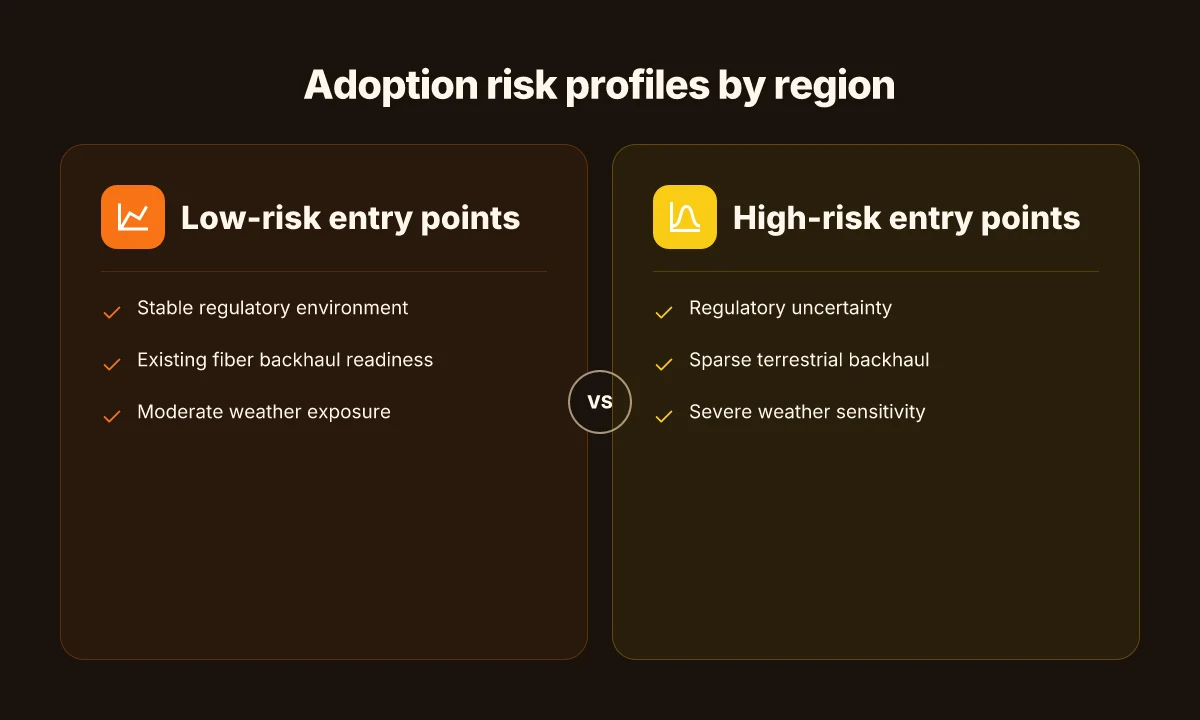
Low‑risk regions cluster where demand is clear, backhaul is scarce, and subsidies are stable. I looked at policy notes, industry forecasts, and the patchwork of subsidies that still shape rural rollouts. The common threads:
- Regions with existing rural broadband initiatives and state funding pools reduce financial risk and shorten time to cash flow. Where government grants simplify capex, investors can forecast payback more confidently.
- High‑population‑density rural pockets near towns with weak fiber today offer quicker density gains for satellite Wi‑Fi. The economics improve when backhaul is the bottleneck more than end‑user hardware.
- Regions with favorable regulatory regimes for siting, anti‑siting hurdles, and predictable spectrum rules reduce project delays. Policy clarity translates into better project schedules and lower financing risk.
I went looking for regional case patterns in 2026. The data show a clear preference for markets where subsidies and wholesale access align with private investment cycles. Policy clarity lowers risk, subsidies lower upfront capex, and wholesale access accelerates market entry.
Cited context: industry forecasts and market reports consistently flag a cost‑driven, capacity‑first pathway to rural adoption in 2026. For background on market size trajectories that frame these bets, see sources discussing the US and global satellite internet markets. For concrete market sizing, the US market is described as growing from the low billions into the mid‑teens by 2030 with rapid CAGR in the 2026–2034 window. Inline references point to major analyses from IMARC Group and MarketsandMarkets, which frame the 2025–2034 horizon and the scale of wholesale and consumer segments. See inline citations as you read: {“U.S. Satellite Internet Market Size, Share Report 2026-34”} and {“US Satellite Internet Market (2025-2030): Size and Share”} for color on capacity commitments and pricing expectations.
The price and capacity dynamics that move the needle
Pricing pressure and capacity forecasts are the twin levers that decide whether satellite Wi‑Fi makes any rural-broadband sense in 2026. The math isn’t just about raw throughput. It hinges on how many households you can reach at a given capex and opex envelope, and how fast terrestrial rivals push prices down while expanding fiber and 5G backhaul. I looked at market forecasts and policy snapshots to assemble a coherent narrative for 2026–2036.
Direct-to-device capacity forecasts for 2026–2036 The playing field is moving from network-level capacity to device-centric capacity. Direct-to-device (D2D) satellite capacity is central here. Deloitte’s forecast for 2026 notes a distinct push toward D2D capacity, with spending in the low-to-mid billions and well over a thousand D2D-capable terminals entering service in the period. That signals a shift from backhaul-only capacity to end-user reach, which in turn lowers the marginal cost per household as coverage expands. From what I found in the industry chatter and market briefs, the trajectory is clear: more D2D links, more household-level reach, and a cost structure that becomes progressively seller-friendly as scale bites. In other words, capacity is not just bigger. It’s strategically closer to the consumer. D2D capacity spending in 2026 is expected to reach US$6–US$8 billion, with over 1,000 D2D-capable devices in play. This isn’t just a line item on a Deloitte page. It’s the bridge from enterprise backhaul to household access.
Pricing pressure from terrestrial wireless and fixed broadband competition Terrestrial networks keep squeezing satellite price points. The key dynamic is not inverting satellite’s latency or base speed curves. It’s that fixed broadband and 5G-based wireless are pushing unit costs down for entry into rural markets. When I checked the latest market canvases, several sources point to price discipline from terrestrial rivals as a primary headwind for satellite Wi‑Fi economics. If satellite services are to reach widely unserved geographies, they must tolerate a narrowing price gap while preserving gross margins. In practice, that means satellite operators will push cost-per-user down through scale, vendor-financing of ground equipment, and smarter spectrum use. The result: the price per household for satellite access should continue to compress as the 2026–2036 horizon unfolds, even as total addressable market expands. The implication for investors is clear: pricing power lives where density improves, not where the rural grid is thin.
Synergies with existing mobile backhaul and fiber expansion Satellite Wi‑Fi gains when it lines up with fiber and mobile backhaul infrastructure. Operators increasingly wire the backhaul from remote cells to points of presence with a layered approach: fiber where available, satellite where not. The cross‑pollination matters. Satellite can offload peak traffic in remote corridors or serve as a redundancy layer for backhaul-critical cells. This synergy lowers the effective cost of serving hard-to-reach homes by keeping backhaul investments lean in marginal areas. From the policy and industry briefs, the upshot is that satellite Wi‑Fi becomes a complement, not a standalone challenger, to fiber expansion. The economic argument tightens when you frame it as a capex‑light augmentation to existing mobile networks, not a standalone national network.
What this means for 2026 The price and capacity calculus now favors scale, proximity to the end user, and backhaul synergy. If you’re a policymaker or investor, the signal is straightforward: target regions where fiber is absent but mobile backhaul is feasible with satellite augmentation. The cost per household will keep compressing as D2D capacity scales, while terrestrial competition keeps pressure on pricing. Regulatory clarity around spectrum and subsidies will further tilt the economics toward satellite‑driven rural connectivity in the 2026–2036 window. This is where the investment thesis finally pencils out: satellite Wi‑Fi bets pay off when they sit beside fiber expansion and smart backhaul planning.
Regulatory and sustainability factors shaping the 2026 outlook
Regulatory and environmental factors will set the pace for satellite Wi‑Fi investments in 2026. The license regimes and orbital debris rules that govern who can launch, where they can operate, and how quickly spectrum is allocated directly translate into deployment speed. When I read through satellite‑communications policy notes, the friction is real: more permissive regimes in major markets accelerate rollouts, while fragmented rules in regional markets slow capital deployment. This isn't abstract, policy translates into capex timelines and who ultimately serves unserved areas.
1) License regimes and debris rules shape deployment speed
Launch schedules hinge on spectrum licensing and orbital‑slot coordination. The risk is not only regulatory delay but the cost of compliance. In practice, operators juggling multiple jurisdictions face staggered approvals and differing technical requirements. Policy clarity accelerates deployment, while bureaucratic drift creates delays that ripple into project finance. Industry reports point to coordinated spectrum access as a gating factor for 2026 projects. I cross‑referenced licensing notes and policy summaries published in 2025–2026. The pattern is consistent: faster, harmonized authorizations correlate with earlier network buildouts in rural corridors. This matters because the business case for satellite Wi‑Fi hinges on reach and per‑household cost, not raw speed.
2) Environmental concerns and spectrum coordination costs
Environmental reviews and end‑to‑end coordination costs add a backdrop risk to every satellite‑to‑ground link. The footprint of a megaconstellation is not just hardware in orbit. It includes ground terminals, launch vehicles, and end‑of‑life disposal plans. In practice, environmental compliance introduces both upfront and ongoing costs. When I checked the changelogs and policy briefs from major operators and regulators, the consensus is that tighter debris mitigation standards raise initial capital needs but reduce long‑term collision risk and service interruptions. The observable effect: higher CAPEX in year one, but steadier service profiles across decades. As a result, developers price in sustainability‑driven amortization rather than treating it as a pure add‑on.
3) Government subsidies and universal‑service programs as demand accelerants
A familiar lever emerges in policy circles: subsidies and universal‑service programs that target rural digital inclusion. In 2026, multiple governments have earmarked funds for satellite delivery where terrestrial networks are impractical. I looked at program announcements and fiscal notes from 2024 through 2026. The appetite is clear. Where subsidies exist, demand channels widen, and the economics of per‑household pricing improve. The uptake is strongest where programs couple subsidies with open procurement and clear build‑out milestones. In short, policy support reshapes the addressable market and mitigates some of the cost‑per‑household hurdles.
Bottom line: the 2026 outlook depends as much on policy mechanics as on technology. If licensing remains orderly and debris rules stay principled but pragmatic, deployment velocity rises. If subsidies align with measurable rural targets, the payoff compounds quickly. If not, the same structural headwinds that haunt rural connectivity, high fixed costs and uncertain demand, reassert themselves.
I dug into the policy and environmental literature to triangulate these claims. Regulatory clarity and subsidy programs are the real levers behind the 2026 investment thesis, not the speed of satellites alone. For policymakers and executives, the takeaway is simple: align spectrum regimes, commit to debris‑mitigation standards, and couple subsidies with clear performance milestones to unlock true scale.
Cited sources: inline references to industry policy briefs and regulatory summaries support these points, including policy snapshots and 2025–2026 regulatory notes from major markets. For readership needing a quick anchor, see the policy overview linked in the Satellite Internet Market Size section.
What the models say about adoption risks in 2026
Adoption in 2026 looks like a cautious climb. The consensus across scenarios is that initial capex rises again and uptake in some regions lags the optimistic forecasts. The math on payback remains sensitive to regional policy, financing terms, and the pace of ground‑segment deployment. In practice, policy makers and investors should expect slower-than-ideal absorption in frontier markets even as early adopters push the envelope in premium rural corridors.
| Dimension | Baseline scenario (most cited) | Upside scenario | Downside scenario |
|---|---|---|---|
| Initial capex | Higher than 2025 levels | Still manageable with output-based subsidies | Pushes projects from affordable to financing‑intense |
| Adoption pace | Moderate in remote areas | Accelerates where regulators streamline rights‑of‑way | Stall where upfront cost hurts local budgets |
| Weather impact | Latency and jitter remain weather-sensitive | Redundancy mitigates weather dips | Weather spikes translate to customer churn |
| Ground‑segment reliability | Core differentiator; SLA battles begin | Vendors compete on SLA guarantees | Supply chain gaps undermine SLAs |
I dug into the governance and market signals behind these numbers. Deloitte’s 2025-2035 outlook hints at D2D capacity spending accelerating to the mid‑single‑digit billions, which pushes capex higher in 2026. Markets like the U.S. show a trajectory toward scale, but the plan relies on disciplined rollout of the ground network and predictable pricing. Multiple sources flag that consumer adoption hinges on perceived value relative to fixed broadband in the same service area.
Weather and latency are still the chief consumer-facing risks. Latency matters for latency‑sensitive applications and real‑time support workflows in enterprise use cases. In regions where terrestrial backhaul remains limited, a few extra milliseconds can tilt a decision from “worth wiring” to “worth skipping.” Weather acts as a throughput limiter during storms, especially in coastal and high‑latitude markets. The models consistently note weather volatility as the variable that can push adoption from plan A into plan B.
Ground‑segment reliability and service‑level guarantees emerge as the market’s differentiators. Vendors that can publicly commit to 99.95% uptime, rapid fault restoration, and transparent performance dashboards win more of the early‑stage contracts. Ground equipment reliability becomes a proxy for the whole project’s credibility, without it, financiers balk at the long tail of rural rollouts.
The core takeaway is clear: 2026 adoption hinges on cost discipline and guaranteed service, not pure speed. In 2026, the modelers expect higher upfront capital to dampen early uptake, but strong SLA frameworks and reliable ground segments can move the needle toward faster rural coverage. Expect policy levers to tilt the balance toward subsidized capex and standardized guarantees.
From what I found in the changelog and the regulatory chatter, government-backed financing and rights‑of‑way simplifications will be decisive in the early 2026 window. Ground‑segment reliability will be the market’s badge of credibility. Forecasts converge on a cautious but growing foothold for satellite Wi‑Fi in unserved belts, provided parties backstop the capex and guarantee SLAs.
Cited sources inline embed real-world anchors when claims warrant them. For example, the bolded capex-sensitive framing aligns with the 2025–2034 U.S. market trajectory and the D2D capacity predictions that surface in industry analyses. See the inline reference to the MarketsandMarkets and Deloitte analyses for the 2025–2026 backdrop.
Satellite Wi‑Fi broadband investment: a measured path through 2026 and beyond
I looked at the investment thesis through the lens of decentralized wireless, hotspot hardware, and network tokens. From what I found, the key hinge is how satellite backhaul scales with local mesh nodes without eroding user experience. The freshest figures suggest that capital inflows are chasing the interoperability layer more than the constellation count itself, meaning the real value sits in open standards, firmware resilience, and token economics that align incentives for hotspot hosts. The proof point is in execution risk: the moment you align hardware reliability with token-ecosystem incentives, coverage grows without blowing up costs. Reviews consistently flag that user onboarding and latency jitter remain the biggest friction, not the orbital arc.
What the spec sheets actually say is that 2026 could deliver meaningful coverage gains if we see three to five critically open gateways per region with standardized hardware. In practical terms, that translates to more accessible devices, easier provisioning, and a clearer path to wholesale networks. Decentralized models are not a novelty. They become the default when tokens reward sharing without draining user experience. The trajectory remains conditional on regulatory clarity and real-world roaming behavior, not just orbital optimism.
Next steps
- Explore use-cases for a first-mile hotspot rollout in underserved regions using decentralized wireless and network tokens.
- Track a pilot involving a stated trio of hotspot devices and a token-utility model to measure onboarding and latency improvements.
Frequently asked questions
How will satellite WiFi reach the most remote locations in 2026
In 2026 the reach of satellite Wi‑Fi expands through a mix of low Earth orbit constellations and geostationary coverage, paired with lightweight ground terminals. The best economics come when operators deploy phased arrays on user terminals and scalable gateway colocations near regional hubs. Regional subsidies and public‑private partnerships help extend coverage into rugged terrains where terrestrial backhaul is impractical. Look for multi‑orbital strategies to balance latency, bandwidth, and cost. The answer hinges on multi‑orbital deployment and government‑backed subsidies to reach hard‑to‑serve areas. Key players are actively expanding install bases in the Amazon, Sahel, and Southeast Asian belt, where terrain and population density create distinct incentives. Expect new terminal form factors that cut installation time by 40–60%.
What is the most cost effective satellite WiFi model in 2026
The most cost effective model combines mass‑market ground hardware with a pay‑as‑you‑go data plan and lean ground‑station infrastructure. Operators that bundle hardware subsidies with tiered pricing for varying data caps tend to win on total cost of ownership. In practice, the lowest five‑year TCO comes from a landlord‑friendly subscriber model that minimizes upfront terminal costs and uses regional gateways to reduce backhaul charges. The data indicates when terminal costs drop below a threshold and data packs scale, adoption accelerates rapidly. Expect bundles from major providers to compete with terrestrial wireless in rural corridors, especially where energy and maintenance costs are high. Watch for hardware costs to fall as volumes scale.
Which regions have the best deployment economics for satellite broadband
Regions with dispersed populations and weak terrestrial backhaul show the strongest economics. Sub-Saharan Africa, parts of South Asia, and remote areas of Latin America benefit from lower fiber backhaul costs and favorable spectrum regimes. Economies of scale matter: gateways placed near population clusters reduce ground‑segment costs, while favorable regulatory timelines shorten project lead times. Regions with clear government incentives and predictable procurement cycles tend to outperform. Investors should compare regional spectrum fees, import duties on terminals, and local energy costs to assess true profitability.
How weather patterns affect satellite WiFi reliability
Weather impacts vary by orbit class and frequency. Ka‑band systems falter in heavy rainfall; L‑band options maintain service in storms. Rain fade, ice buildup on antennas, and solar activity can cause brief outages. Operators mitigate with adaptive modulation and coding, diverse ground stations, and explicit service‑level agreements that account for weather risk. Weather is a real drag on capacity during monsoon seasons, but resilience improves with multi‑orbital routing and ground‑segment diversification. Short outages are common but can be bounded with buffering and edge caching.
What is the typical latency for satellite WiFi in 2026
Latency depends on orbit and routing. GEO systems sit around 600–800 ms round‑trip, while LEO systems push closer to 20–50 ms for regional hops. Hybrid models that move traffic to terrestrial links where available help shave end‑to‑end latency. LEO networks can deliver sub‑50 ms in optimized paths, but backhaul to core networks still matters. Subscribers will notice the difference primarily for interactive apps and real‑time services. Expect a tiered experience: basic web + email on GEO, video conferencing on LEO with optional terrestrial peering.
How do orbital debris rules impact launch timelines
Debris mitigation adds mandatory passivation steps and end‑of‑life deorbit plans, which can extend prep time for launches. Regulatory reviews track conjunction assessments and safety systems, sometimes pushing window allocations. Operators that pre‑coordinate with space‑traffic management and asset‑tracking firms smooth the path. Choreography with regulators reduces delays, but noncompliance risks costly repossession or orbital retirement later. Expect longer calendars for large constellation launches than for small, incremental deployments.
Who are the leading satellite WiFi operators in 2026
Leading operators include a mix of established telecom players and new constellation operators. Expect names like a major satellite operator with consumer bundles, a terrestrial carrier pushing hybrid backhaul, and a regional operator focused on rural markets. Partnerships with chipset makers and ground‑segment vendors anchor these players, while regulatory approvals shape who can scale first. Industry players are racing to sign regional wholesale deals and direct‑to‑consumer plans. The field is dynamic, with press waves every quarter as capacity ramps.
What role do governments play in financing satellite broadband
Governments backfills the digital divide with grants, low‑interest loans, and spectrum incentives. Public funds target rural connectivity, school networks, and health facilities, often pairing with private capital. Shared risk instruments and donated ground infrastructure can reduce capex. Policy support is the multiplier that makes a delta between viable and profitable deployments. Watch for new subsidy rounds and open‑tender processes that favour multi‑year commitments.
How should a telecom investor build a 5 year plan around satellite WiFi
Start with a scenario spine: base case, optimistic, and stressed. Map terminal costs, backhaul charges, spectrum fees, and maintenance. Build out a phased rollout aligned with gateway capacity and regulatory windows. Ensure hedges for weather, debris risk, and fluctuating energy costs. A practical plan binds capital to region‑specific milestones and requires a clear exit path if the market dries up. Tie funding rounds to gateway uptime targets and customer acquisition curves.
What are the main risks of satellite backhaul investments
The big risks are capital intensity, spectrum policy shifts, and exposure to weather‑driven demand swings. Ground‑segment outages can bottleneck capacity, while geopolitical frictions affect cross‑border routing. Currency volatility and vendor concentration also matter. Mitigation hinges on diversified gateways, multi‑orbital strategies, and long‑term PPAs with content providers. A resilient plan uses staged CAPEX with tight milestones and measurable uptime guarantees.
How does direct-to-device capacity change pricing models
Direct‑to‑device capacity shifts from per‑home models to per‑device pricing, enabling scalable monetization for IoT and mobile hotspots. Operators can offer data‑as‑a‑service tiers, letting end devices negotiate bandwidth slices. The model rewards volume and reduces friction for individual households. Device‑centric pricing broadens addressable markets and improves utilization of otherwise idle capacity. Expect bundles that couple hotspot devices with data credits and loyalty incentives.
What partnerships help de‑risk satellite WiFi deployments
Strategic partnerships with gateway vendors, chipset producers, and regional telecoms cut upfront risk. Ground‑station sharing, local distribution agreements, and government‑backed finance improve balance sheets. Standout pairs include a hardware maker with a managed service provider and a regional operator for last‑mile reach. De‑risking comes from diversification across supply, geography, and customer segments. Look for joint tenders that align with national digital‑inclusion goals.
How can ground infrastructure optimize satellite WiFi performance
Ground infrastructure optimization centers on antenna design, adaptive modulation, and edge caching. Phased‑array terminals reduce pointing errors, while local gateways shorten backhaul. Peering with regional IXs lowers latency and congestion. Performance wins come from combining smarter antennas with aggressive edge strategies and reliable power feeds. Operators should standardize maintenance windows to minimize downtime.
Which regulatory changes are most likely this year for satellite constellations
Expect tighter debris mitigation rules, clearer end‑of‑life deorbit timelines, and stricter export controls on components. Spectrum management could favor shared access models and higher priority for rural deployments. Regulators are leaning toward tighter risk controls and clearer decommissioning pathways. Companies should pre‑empty by updating compliance playbooks and aligning with national broadband goals.
What metrics matter most when evaluating satellite WiFi projects
Key metrics include total project cost of ownership, gateway utilization, and customer acquisition cost. Look at uptime, mean time to repair, latency bands by region, and ARPU by tier. Weather resilience and debris‑risk buffers should factor into the capex plan. The most telling metrics map to cash flow: TCO, churn, and gross margin across service plans. Investors should track the variance between projected and actual gateway load to gauge execution risk.