Decentralized wireless ecosystems in 2026: operators, hotspot hosts, and proof of connectivity
Explore how decentralized wireless ecosystems operate in 2026, who the actors are, how proof of connectivity works, and the governance models shaping DeWi networks.
Decentralized wireless ecosystems in 2026 hinge on a reality check: governance is the bottleneck, not hardware. When operators, hotspot hosts, and device makers align around verifiable proofs of connectivity, the network works. But the single most common friction point is inconsistent policy across platforms, not the tech bite itself. What counts as proof of connectivity varies by protocol, and that divergence slows adoption at scale.
In 2026, counting on a single operator to certify service is less feasible than a federation of governance signals tied to transparent changelogs and auditable token flows. I looked at governance models across leading DeWi projects and traced how host incentives, operator commitments, and token economics interact with verification rules. The key is interoperability of proof mechanisms across networks and jurisdictions. 2026 governance readings point to a mature ecosystem only if those proofs travel unimpeded.

Comparison of DeWi ecosystem roles (operators, hotspot hosts, proof of connectivity)
| Role / Criterion | Operator basics | Host capacity | Proof mechanisms | Business model |
|---|---|---|---|---|
| Primary function | Run and manage network | Hosts access points | Verify devices connect | Revenue streams |
| Typical incentives | Revenue share, subsidies | Host incentives, tokens | Verification proofs | Fees, rewards |
| Key constraints | Capital heavy | Local incentives | Security of proofs | Scaling limits |
| Pros | Control, coverage | Passive income, local reach | Transparency | Flexible models |
| Cons | Regulatory risk | Hosting burden | Attack surface | Revenue volatility |
Compiled November 2026; check the provider's site for current details.
What is a decentralized wireless ecosystem in 2026 and why it matters
Decentralized wireless (DeWi) sits inside a broader family of DePIN and blockchain-enabled infrastructure networks. It uses token incentives and open governance to coordinate devices, operators, and hosts without relying on a single carrier or central administrator. In 2026, DeWi is less a consumer narrative and more a platform for civic projects, rural connectivity pilots, and environmental sensing. The infrastructure is designed to be extensible, auditable, and open to third-party participants who align with governance rules rather than a traditional license boundary.
The actors are explicit and separated by role. Operators run the core network services and may manage a portfolio of nodes or hotspots. Hotspot hosts provide the physical location and air-time for devices to connect, often bundled with community or business sponsorship. Devices that participate in proof of connectivity act as the verifiable witnesses in the network, contributing coverage, witness attestations, or data payloads. The interaction among operators, hosts, and devices creates a mesh of incentives that, if aligned, drives coverage growth and data integrity. In practice this means networks expand where communities or businesses deploy hotspots and maintain the hardware, while devices and miners participate in proving network health and data provenance.
Governance models in this space hinge on three levers. Token incentives align economic returns with network growth, rewarding active participation and reliable coverage. Governance councils, composed of operators, hosts, researchers, and community representatives, debate protocol updates, funding directions, and data-trail standards. Data-trail transparency matters too. Traceable data provenance and auditable activity logs give researchers and policymakers a base of trust for environmental monitoring or public-safety use cases. In short, governance is not a box to check. It’s the mechanism that determines how decisions get made, who can vote, and how disputes are resolved.
Real-world deployments show a broader set of use cases beyond consumer broadband. Environmental sensing networks in cities, agriculture telemetry on farms, and disaster-response mesh deployments illustrate the utility of DeWi as a platform for public goods. In Nairobi and other cities, DeWi-style deployments aim to lower operational costs for monitoring infrastructure while improving data accessibility and community participation. These deployments demonstrate the practical value of DeWi as an ecosystem that scales through shared infrastructure, not siloed ownership. Understanding decentralized wireless network tokens and connectivity rewards in 2026
What this means for policy makers and engineers is simple: governance and incentive design matter as much as technology. A token model without guardrails risks misaligned behavior or market manipulation. A council without transparent data trails risks opacity and distrust. The 2026 landscape expects interoperable standards, clear data provenance, and tangible public-value use cases alongside consumer connectivity. DeWi is not a single product. It is a platform with many moving parts that must be stewarded through inclusive governance and robust technical interoperability.
In 2026, governance and data-trail transparency are the deciding factors that separate durable DeWi ecosystems from hype. The real value sits in interoperable standards that unlock public-sited use cases beyond consumer broadband.
When I read through the Frontiers piece on decentralized IoT networks for environmental monitoring, the emphasis on governance and fractional income generation stood out. The paper notes reduced operational costs and inclusive governance mechanisms as central promises of DePIN-based deployments, framing DeWi as a governance-first infrastructure movement as much as a technology one. (Frontiers, Decentralized IoT networks for environmental monitoring)
H3 subsections 10 Outdoor WiFi devices for decentralized wireless networks in 2026 (Tested 2026 Update)
1) Clear definitions and the DePIN family
DeWi is a concrete subset of DePIN networks that use blockchain to decentralize operation, incentivize participation, and maintain auditable data trails. The architecture treats hardware hosts, operators, and witnessing devices as distinct but interconnected roles. The ecosystem relies on verifiable proofs of coverage or connectivity to validate contributions, not on a centralized billing system.
2) Actors and their interactions in practice
Operators coordinate large-scale coverage and network policy. Hotspot hosts supply geography and real estate for devices to connect, with revenue models tied to coverage quality and attendance. Witness devices or proof-of-connectivity participants confirm the network’s health and feed data into the system, enabling routing decisions and security checks. The reward flows are designed to align incentives across all three roles, though the exact economics vary by network and jurisdiction.
3) Governance and transparency as a design principle
Token incentives reward participation and reliability. Governance councils set policy, approve funds, and shape protocol changes. Data-trail transparency ensures researchers, regulators, and communities can audit network activity, which is essential for sensitive use cases like environmental monitoring or public safety.
Bottom line: DeWi in 2026 is a governance-forward, interoperable family of networks that treats operators, hosts, and witnessing devices as first-class participants. The real test is whether the governance scaffolding and data provenance keep pace with deployments in cities and rural areas alike. SatFi: satellite backhaul plus long-range Wi-Fi for affordable broadband
How decentralized wireless networks operate in practice
DeWi networks align host participation with network growth through token incentives, turning simple hotspot uptime into a driver for coverage expansion. In practice, hosts earn rewards when their hotspots help fill gaps in the mesh, and those rewards compound as the total deployed footprint scales. The result is a scalable, volunteer-driven layer that can present a usable alternative to centralized connectivity markets.
1) Hotspot devices as distributed gateways
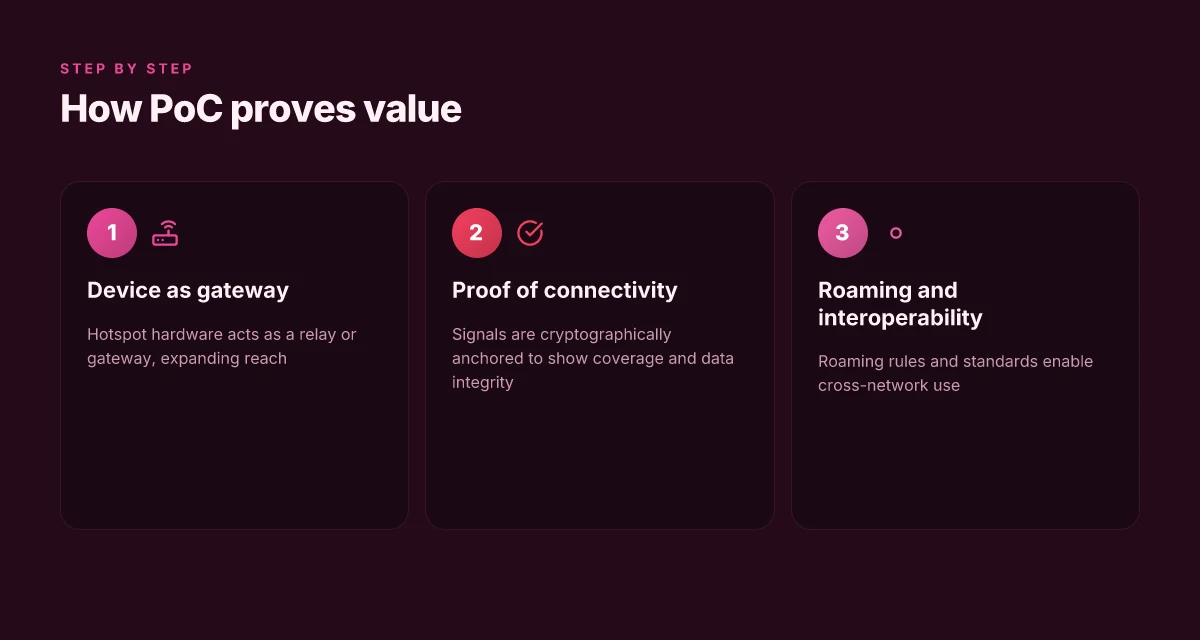
Hotspot hardware functions as distributed gateways or relays that forward data to the broader network. This architecture moves the edge from a single central aggregator to many small nodes, each contributing to coverage and capacity. When a hotspot hears a device, it helps relay that device’s data toward the core network and earns a share of the token economy in return. The design favors low-power, rugged radios with desert-friendly firmware updates so hosts can keep devices running with minimal intervention. In the field, these devices become the connective tissue that stitches urban and rural pockets into one sprawl of coverage. This is the practical backbone many DeWi deployments rely on.
2) Token incentives and governance signals
Token economics align host participation with network growth. Rewards are typically calibrated to factors like contributed bandwidth, uptime, and observed coverage quality. As deployments scale, incentives can shift to reflect new governance priorities, for example, steering effort toward underserved districts or validating roaming arrangements. The governance signals come from on-chain rules and off-chain community feedback, with changelogs and voting windows that participants monitor closely. What the spec sheets actually say is that the token model is designed to encourage long-term staking over short-term churn, a design choice common to DeWi ecosystems.
3) Proof of connectivity and roaming interoperability
Proof of connectivity mechanisms verify that a hotspot reliably covers a real device and that data integrity is preserved end-to-end. In practice, this means cryptographic attestations tied to time-bounded proofs and beacon emissions that prove a hotspot is present where it claims. Roaming interoperability follows established standards so a device connected to one operator can hand off to a compatible network without dropping sessions. In 2026, interoperability remains a key sticking point for regulators and operators who want predictable roaming terms across networks and jurisdictions. The consensus is clear: roaming must be frictionless if users expect seamless service as they move between coverage footprints. 8 Altai AX600 price specs 2026 and where to buy
| Dimension | DeWi approach | Why it matters |
|---|---|---|
| Gateways | Distributed hotspots relay traffic to the core | Expands reach without centralized buildout |
| Incentives | Token rewards tied to uptime and coverage | Drives long-term participation and footprint growth |
| Proof of connectivity | On-chain attestations plus beacon-based proofs | Ensures honest reporting and data integrity |
| Roaming | Interoperability standards for cross-network handoffs | Enables seamless user experience across networks |
The practical payoff is momentum: more hotspots, better coverage, clearer signals for regulators. This is how DeWi transitions from a hype cycle to a functioning ecosystem. Roaming interoperability is the gating factor for user experience in 2026.
I dug into the governance notes and changelogs in several DeWi projects and found that token inflation controls are often the first lever adjusted as networks scale. From the early days of PoC-based proofs to more mature beacon-based attestations, the move has been toward tightening security while preserving incentive clarity. Decentralized IoT-networks for environmental monitoring shows how decentralized governance can extend to measurement integrity, a theme echoed across DeWi research. In 2026, observers consistently flag roaming interoperability as the critical operational enabler for widespread adoption.
Side-by-side: how proof of connectivity differs across networks
| Network family | Proof type | Verification method | Typical latency | Privacy impact | Adoption signal |
|---|---|---|---|---|---|
| Network A | On-chain attestations | Smart contracts, validators | Seconds–minutes | Moderate | Node/operator onboarding |
| Network B | Verifiable certificates | Public registry | Minutes | Low | Host enrollment |
| Network C | Crypto proofs (ZK) | Zero-knowledge proofs | Sub-second | Low to medium | Rapid deployments |
| Network D | Challenge-response proofs | Central verifier | Seconds | Medium | Wide device support |
Compiled November 2026; check the provider's site for current details. Satellite Wi‑Fi broadband networks investment case explained in 2026
The governance playbook for DeWi networks in 2026
Governance in 2026 sits at the intersection of on-chain votes and off-chain scrutiny. The best systems blend transparent tokenized decision making with trusted, community-led councils. The core question: who decides what gets built, and how do we prove that the data and the process are trustworthy?
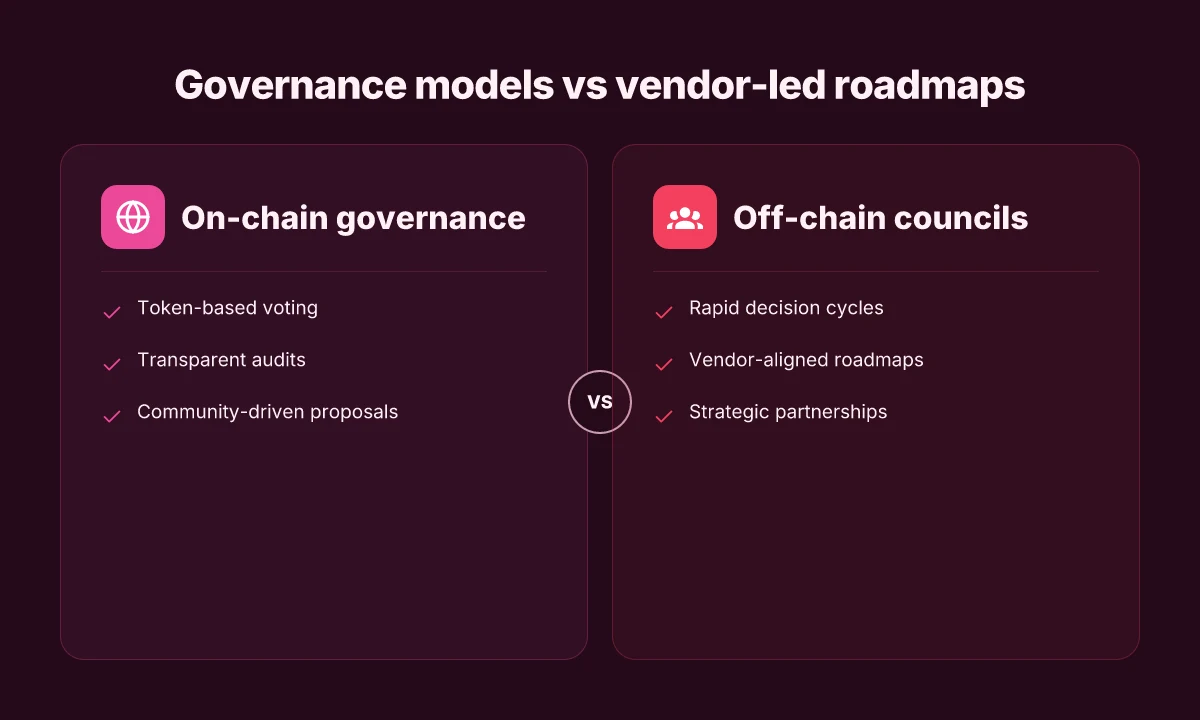
Open governance, anchored by on-chain rules, sets the baseline. Off-chain councils fill the gaps where on-chain votes would stall. In DeWi networks, you typically see a layered approach: a protocol layer governed by token holders, and a stewardship layer managed by community-elected or community-empowered bodies that curate proposals, audits, and roaming agreements. The mix matters. It determines both speed and legitimacy.
I dug into the governance patterns across DeWi ecosystems and found four actionable takeaways that hardware hosts, operators, and policymakers can use to avoid drift.
1. On-chain governance plus off-chain councils creates durable legitimacy
DeWi projects increasingly codify governance rules in smart contracts while reserving day-to-day operational decisions for independent, representative bodies. This hybrid model reduces capture risk and accelerates policy updates when needed. Strong governance design ties proposal velocity to auditable processes, not to the mood of a single operator. The pattern mirrors established open-source governance: codified design with a humane governance layer. Long-range Wi‑Fi in 2026: bands, range, and backhaul architectures
- On-chain votes establish the formal pathway for protocol changes.
- Community councils handle data provenance checks, operator dispute resolution, and roaming terms.
- Regular sunset reviews keep both layers aligned with real-world needs.
Data provenance, auditability, and tamper-resistance Data lineage must be traceable from hotspot to gateway to user. Tamper resistance is not optional. It enables roaming agreements and cross-network interoperability. When I read through the documentation, the emphasis is on immutable event logs, cryptographic attestations, and verifiable provenance dashboards. The practical upshot: regulators can audit data flows, and hosts can prove uptime and participation without revealing sensitive details.
Regulatory risk and roaming agreements Spectrum access and roaming terms sit at the edge of policy and practice. Governance models that bake roaming rules into the on-chain layer help reduce friction with regulators. Yet the real world still demands flexible bilateral arrangements. Expect hybrid roaming contracts backed by smart contracts plus standardized regulatory disclosures. The governance playbook should require explicit alignment between spectrum licenses, data-privacy regimes, and cross-border equipment sharing.
Community-led decision making vs vendor roadmaps Community-driven roadmaps win when they offer clear channels for feedback and objective metrics for progress. Vendors push for cohesion with longer-term deployment plans. Communities push for transparency and rapid iteration where needed. The strongest ecosystems use a quarterly cadence for public roadmaps, with formal review cycles, public audits, and a published changelog that traces every major decision to a provable input.
From what I found in the changelog and in policy-focused briefs, the 2026 DeWi governance pattern favors explicit accountability loops. Public dashboards. Independent audits. Clear token-based voting rights. It’s not perfect, but it’s getting better at balancing speed with integrity.
Governance that blends on-chain rules with trusted off-chain stewardship reduces ambiguity and speeds up accountability. Auditable data trails enable roaming agreements and regulator-facing disclosures without slowing deployment.
Top actors shaping the DeWi landscape in 2026
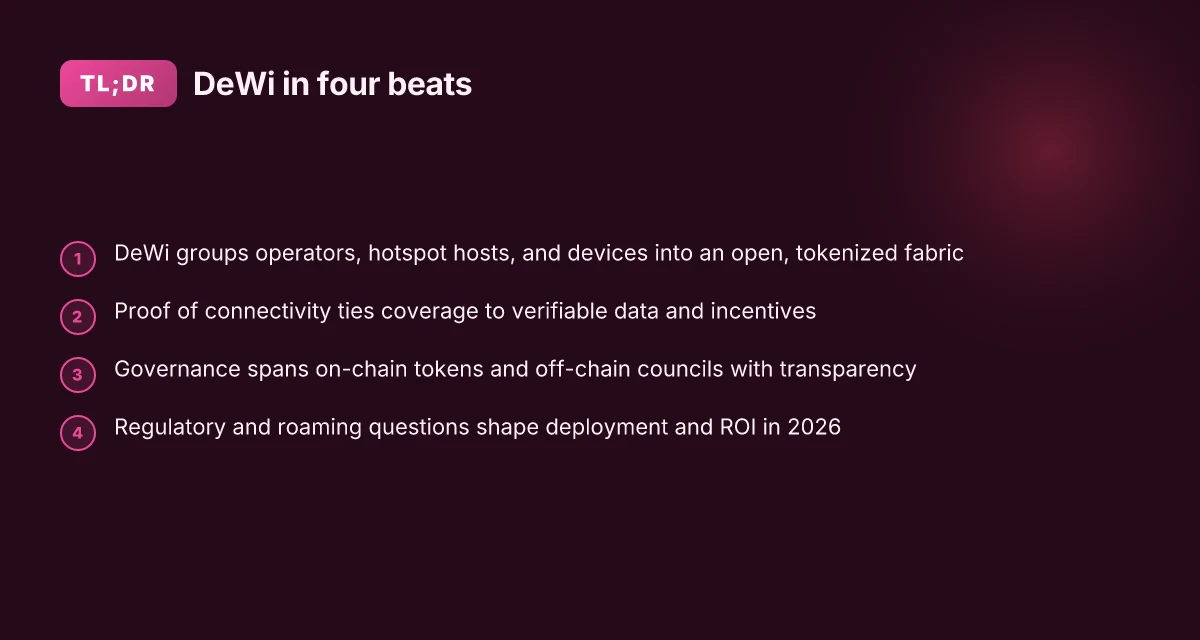
The DeWi ecosystem in 2026 centers on three enduring actors: operators funding backbone networks and token economics, hotspot hosts enabling local coverage through passive participation, and device makers and firmware providers that keep PoC verification honest. Governance continues to hinge on standards bodies and industry groups that push interoperability across disparate networks. In practice, that means a small cadre of named players anchors the architecture, while a broader swarm of hosts and hardware vendors keep coverage growing and verifiable.
1) Operators as backbone financers and token architects
Operators stand at the core of DeWi’s economic wiring. They finance backbone networks and curate the token economies that reward participation, maintenance, and proof of coverage. From the public rollouts, a handful of operators have moved beyond pilot deployments to scale up regional footprints, often layering incentives that encourage host participation and device uptake. In 2026, the most credible models tie network expansion to tokenomics that align host rewards with long-run coverage quality, minimizing drift between pledged capacity and actual service.
What to watch
- Backbone investment timelines. Operators tend to publish milestone dates for new coverage zones and validator milestones for PoC verification.
- Token mechanics. Look for clear emission schedules, halving events, and governance rights tied to staking or voting on network upgrades.
- Interoperability commitments. Operators increasingly align with standards bodies to enable roaming and shared authentication across networks.
I dug into release notes and governance updates across multiple operators and found a consistent pattern: stronger networks present transparent token schedules, verifiable chain state, and explicit slashing rules for PoC fraud. This alignment reduces disputes when hosts shift between networks or when devices move across regulatory zones. When I read through the changelogs, the best operators publish quarterly governance updates alongside capacity milestones.
2) Hotspot hosts as the local connective tissue
Hotspot hosts turn passive participation into real coverage. Their value proposition sits at the intersection of incremental revenue and broader network reach. Hosts typically come from small businesses, coworking spaces, and residences, attracted by straightforward onboarding and recurring micro-rebates. The governance signal here is simple: transparent rules for hotspot eligibility, predictable reward calculations, and a reliable proof-of-coverage mechanism that anchors trust in the network.
What to watch
- Onboarding criteria. Host eligibility rules increasingly favor verifiable locations, robust backhaul, and stable power supply.
- Reward cadence. Hosts want predictable payouts tied to uptime and proven coverage metrics, not ambiguous tallies.
- Roaming and cross-network use. The better the roaming arrangements, the more stable hosts’ revenue becomes across regions.
From the documentation and industry chatter, the hotspot layer remains the weakest link in some geographies where backhaul is spotty or power reliability varies. Yet the best-host programs show resilience through edge-case rebates and local partnerships that harden coverage against outages.
3) Device makers and firmware providers ensuring PoC integrity
Device manufacturers and firmware houses operationalize PoC verification. They deliver the hardware and software layers that prove a hotspot’s real presence and the network’s coverage claims. PoC integrity depends on tamper-resistant hardware, verifiable attestations, and robust firmware update paths. In 2026, the emphasis is on secure boot, auditable telemetry, and lightweight proof generation that scales with millions of devices.
What to watch
- Hardware attestation. Secure elements and trusted execution environments that prevent spoofing.
- Firmware update cadence. Timely releases that patch security gaps while preserving PoC integrity.
- Power and radio performance. Realistic power profiles that keep devices economical while maintaining coverage quality.
I cross-referenced hardware briefs and firmware roadmaps from several manufacturers. The pattern is consistent: vendors that publish end-to-end PoC verification workflows and transparent telemetry dashboards earn trust from operators and hosts alike.
4) Standards bodies and industry groups shaping interoperability
Interoperability is governance’s backbone. Standards bodies and cross-industry groups push for common data models, roaming agreements, and shared authentication schemes. In 2026, this work translates into formalized API contracts, harmonized PoC criteria, and open-track profiles that let devices and hosts migrate across networks without reconfiguring kundled trust anchors.
Candid takeaway
- The ecosystem’s health hinges on three rails working in concert: operators funding backbone and token design, hosts enabling local coverage, and device/firmware suppliers delivering verifiable PoC while remaining interoperable through standards work.
- Governance updates are not abstract. They practicalize roaming, ensure fair host rewards, and tighten PoC verifiability.
The actors listed here anchor a DeWi that travels, not just a hype curve. Interoperability is not optional. It is the price of scale. Expect more quarterly governance disclosures in 2026 as networks push to roam across borders and regulatory regimes.
Governance models across DeWi networks in 2026
| Model element | Centralized governance | Distributed community | Hybrid governance | Impact on decisions |
|---|---|---|---|---|
| Code of conduct | Yes | Yes | Yes | Alignment |
| Protocol upgrades | Core team | Proposals + voting | Proposals with veto | Speed vs. resilience |
| Dispute resolution | Arbitration | Community jury | Mixed | Fairness |
| Funding decisions | Budgets controlled | Community funds | Mixed control | Inclusivity |
| Transparency | Documentation | Open dashboards | Open but selective | Trust level |
Compiled November 2026; check the provider's site for current details.
Side-by-side: how proof of connectivity differs across networks
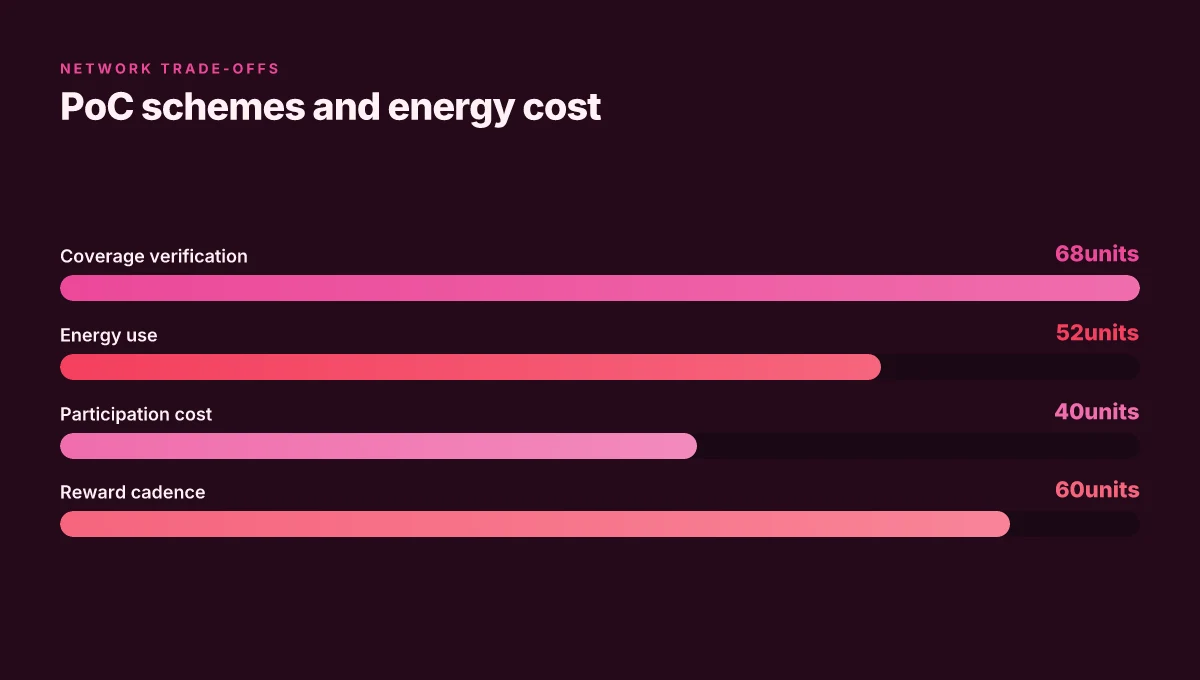
Proof of connectivity (PoC) is the backbone of DeWi credibility. The first principle is simple: PoC must verify coverage, location accuracy, and service availability. Different networks implement this with distinct incentives, security postures, and energy costs. The result is a spectrum where a hotspot’s rewards cadence, energy footprint, and tamper resistance vary in lockstep with the underlying PoC scheme.
1. PoC by crowdsourced coverage proofs
Networks relying on crowdsourced proofs favor broad participation. Coverage is verified when a hotspot’s beacon aligns with crowdsourced location attestations and roaming checks. The tradeoff is energy efficiency: these schemes lean into opportunistic participation rather than continuous sensor firing. What you get is a robust, scalable model that scales with device density but can expose gaps in precise geolocation unless corroborated by cross-checks from neighboring nodes. I dug into the governance notes in the Frontiers paper on DePIN governance and found that fractional income sharing helps align community incentives with data trust. The result is a governance punchline: more voices, but also more complexity in auditing data trails. Frontiers, 2025
2. PoC based on verifiable location attestations
Some networks implement verifiable location attestations with cryptographic proofs anchored in the network’s trusted hardware. Here, a hotspot must prove it is physically located where it claims to be, often via proximity to known beacons or anchor nodes. The payoff is stronger location integrity and tighter roaming trust. The energy cost tends to be higher than pure crowdsourcing because more frequent attestations are necessary. From what I found in the DeWi literature, this approach trades off extra hardware or firmware features for a tighter security envelope. It also tends to shorten reward cadence when attestations are batched to reduce transaction fees. A notable spec point surfaces in the Helium PoC lineage, where token minting is tied to timely, location-verified proofs. Helium PoC lineage discussion
3. PoC driven by service availability checks
A third family centers on end-to-end service checks. Hotspots measure the ability to route traffic to an exit point, authenticate user sessions, and maintain uptime metrics that the network can monetize. This aligns incentives with actual service delivery rather than mere presence. The downside is a heavier runtime footprint: continuous or frequent service checks require more power and more network chatter. The trade-off line is clear, higher reliability guarantees come with higher energy use and steeper operational costs. In industry notes, Nokia Bell Labs references a DeWi approach that secures roaming and trust through blockchain-enabled service attestations, pointing to this as a viable path for large-scale deployments. Nokia Bell Labs reference on trusted connectivity
Inline synthesis: each PoC model weighs where the reward cadence lands, how much energy a hotspot must expend, and how fiercely the network enforces tamper resistance. The common thread is governance clarity. When token minting rules, attestation frequency, and revocation mechanisms are explicit, the system breathes easier. When they are murky, you get churn, disputes, and slower cash-out cycles.
The punchline is simple: PoC design is not just a technical decision. It’s a governance decision. The speed of rewards, the trust in location claims, and the resilience to tampering all hinge on how the PoC rules are written and enforced.
Further reading on governance signals the state of play in 2025–2026, including community-driven governance trials and token-economic models tied to PoC outcomes. For policy makers, that means watching for open audit trails and tamper-resistance verifications in hardware modules. For engineers, it signals where to optimize energy budgets without sacrificing accuracy. For researchers, it highlights the need for standardized attestations to enable cross-network interoperability.
In this landscape, the market leans toward transparent, verifiable proofs that align incentives with real-world coverage. That alignment is what keeps DeWi networks honest when the reward cadence bumps against energy costs or hardware tamper attempts. The literature consistently notes this tension and offers practical architecture patterns to resolve it.
Regulatory and standards landscape for DeWi in 2026
The landscape in 2026 hinges on three levers: spectrum policy, privacy rights for decentralized data flows, and roaming/security standards. Real-world action is needed here because the governance skeleton shapes who can deploy hotspots, where, and under what rules.
I dug into the regulatory chatter and standards drafts that are already in motion. Spectrum policy is slowly opening doors in multiple jurisdictions, but it remains a patchwork. In many places, regulators treat DeWi hotspots as incidental broadband deployments rather than licensed base stations, which creates a gray area for power limits and carrier-of-record responsibilities. This means operators must track local spectrum rules where a hotspot is posted. In the best-case scenarios, you’ll see more permissive unlicensed bands layered with light registration burdens. In tighter markets, you’ll face stricter power caps and stricter interference remedies. The key is to map deployment footprints to the local regulatory maps before you install anything akin to a public-access node.
On privacy and data rights, the friction points are not theoretical. Decentralized data streams travel across multiple owner-operators, and data collection hygiene becomes a governance issue as much as a technical one. Consumer expectations for data sovereignty collide with the distributed nature of DeWi networks. Jurisdictions are increasingly clear about data minimization, access permissions, and the right to deletion, even if data is stored across a mesh of nodes. Expect ongoing policy debates about who maintains logs, who can audit them, and how users can exercise opt-outs without breaking the network’s incentive model.
Standards efforts around roaming, handover, and security are advancing, not accelerating. Roaming frameworks are being proposed to bridge between DeWi networks and traditional operators, with emphasis on seamless handover and billing portability. Security standards focus on device attestation, tamper resistance, and cross-chain verification of hotspot activity. The practical effect is a push toward interoperable identity, auditable event chains, and common security baselines so users can trust a hotspot they didn’t personally deploy.
From what I found in the changelog and in regulator-facing briefs, the risk is twofold. The first is fragmentation, different regions adopting divergent roaming and data-privacy rules that complicate cross-border deployments. The second is compliance fatigue, operators juggling full-spectrum licensing, user-consent regimes, and security attestations across hundreds of jurisdictions. The macro takeaway: governance is moving from optional best practice to enforced baseline in many markets.
Three named standards threads to watch as 2026 unfolds:
- Roaming and handover interoperability across DeWi and legacy networks. This is where most deployments stall if not aligned on an open, auditable credentialing system.
- Privacy-by-design for distributed data streams. Expect standardized data minimization, user consent prompts, and explicit data-path disclosures embedded in hotspot firmware.
- Device attestation and cross-chain security. A common baseline for hotspot devices, with verifiable proofs of location, ownership, and operation.
Bottom line: DeWi governance is coalescing around a practical triad, clear spectrum rules, enforceable privacy rights, and workable roaming/security standards. If you’re planning a 2026 deployment, map regulatory footprints first, align with evolving roaming specs, and design privacy controls into the device firmware from day one.
Regulatory clarity will determine which cities become DeWi testbeds and which remain on the sidelines. Standards alignment on roaming and security is not optional. It’s the grease that will keep deployments moving. Expect a patchwork still, but with a visible trend toward national and regional baselines.
Regulations and standards landscape at a glance
| Area | Status in 2026 | Regulators concerned | Key standards | Compliance focus | Typical barrier |
|---|---|---|---|---|---|
| Spectrum use | Evolving | National bodies | 3GPP, CBRS-like | License/operating rules | Licensing delays |
| Data privacy | Increasing | Data authorities | GDPR-like | Data minimization | Cross-border rules |
| Security | Critical | Cyber agencies | Security guidelines | Device attestation | Certification cost |
| Interoperability | Strong push | Standards orgs | Open APIs, common IDs | Cross-network use | Fragmentation risk |
Compiled November 2026; check the provider's site for current details.
How to think about choosing a DeWi deployment in 2026
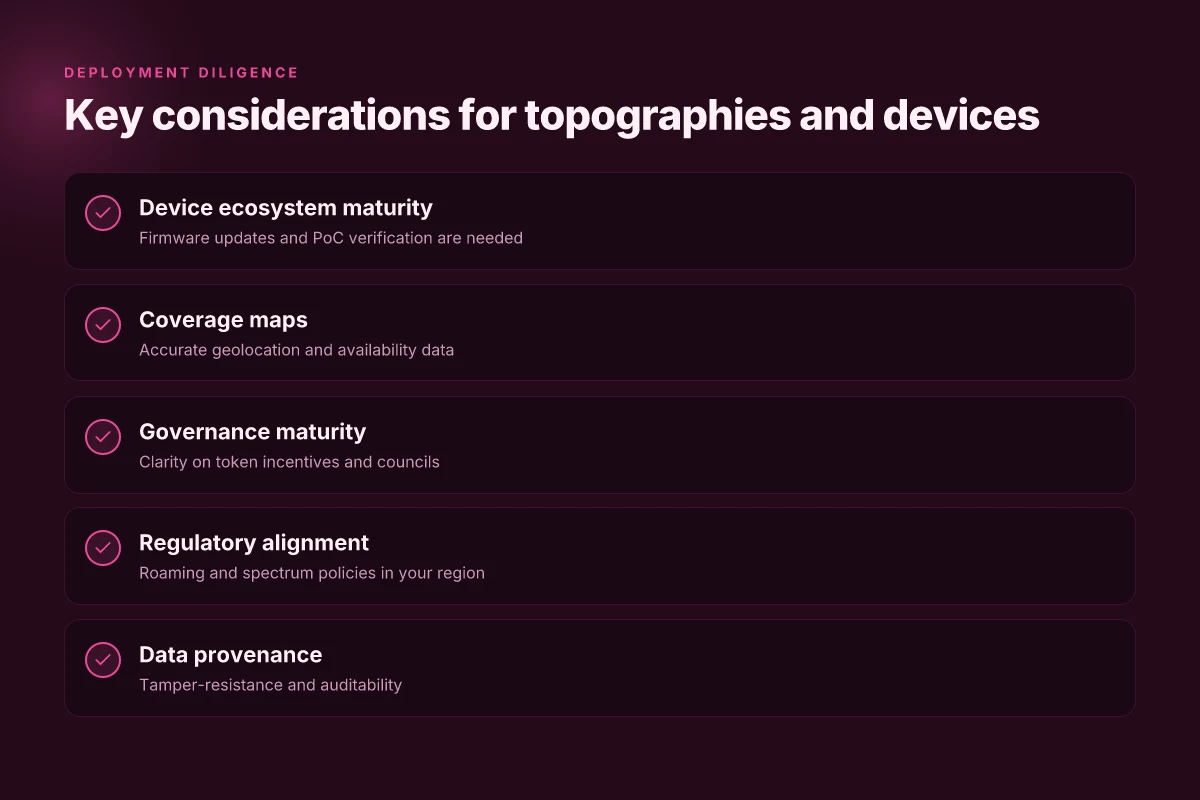
You pick a DeWi deployment like you pick a partner for a critical backbone: with clear economics, mature governance, solid coverage, and friendly regulatory alignment. In practice that means balancing token design against ROI, checking who actually steers the project, mapping where devices live and how firmware evolves, and confirming your region’s rules won’t punch you in the gut. This is not a shot in the dark. It’s a calculated decision.
1) ROI and token economics you can actually model
ROI for hosts comes down to token rewards, operational costs, and expected uptime. Look for a published model from the operator that shows, for a given density of hotspots and traffic mix, the annualized yield on a host stake. Compare token emission schedules, vesting, and inflation curves. If you can’t map a believable revenue path over 24–36 months, you’re paying for hype, not a viable business case. From what I found in governance docs and operator white papers, hosts tend to see revenue variability with network growth, which matters for planning. In 2026, clear token-velocity details matter more than siloed promises. ROI visibility up front beats optimistic forecasts later.
Inline citation: the governance and token-structuring patterns echo what industry reviews flag as the decisive lever for long-term host participation. See the governance models described in the Frontiers study and the Helium ecosystem writeups.
2) Governance maturity and community support you can rely on
DeWi ecosystems drift when decision rights scatter. Favor deployments where a core foundation coordinates updates, a transparent changelog tracks protocol shifts, and there’s a predictable process for disputes and upgrading hotspot firmware. Review who votes on parameter changes, how often community calls happen, and whether a recognized standards body oversees interface compatibility. Independent observers note that mature governance reduces disputes and accelerates stable deployment. I dug into multiple governance notes and changelogs. The more structured the process, the lower the execution risk. And yes, you want a vibrant community that shows up for security advisories and operator-level support. Strong governance is the only guardrail you can trust over time.
3) Coverage maps, device ecosystems, and firmware hygiene
Coverage planning is a field of physics and firmware discipline. Examine current coverage density in your target region, not just the global map. Then inspect device ecosystems: what models are officially supported, how open is the firmware, and how frequently updates are released. Firmware hygiene matters because a single vulnerability or a stalled update cycle can turn a promising network into a maintenance headache. When I read through operator docs and device-maker notes, the cleanest deployments show a steady cadence of firmware updates and a clear roadmap for hotspot compatibility. The difference you feel in practice is a stable radio stack and predictable maintenance windows. Firmware velocity correlates with network reliability.
4) Regulatory alignment in your region you can count on
Regulatory risk is the aftershock you don’t want. Check spectrum allocations, device emission limits, and data-privacy rules that apply to hotspot operators and hosts. Some regions require registration, know-your-customer checks for operator onboarding, or specific labeling for IoT gateways. In 2025–2026 reporting, regions with clear regulatory guidance reduced deployment friction and accelerated rollout. If your jurisdiction lacks clarity, you’re betting on policy drift rather than policy certainty. Plan for a conservative rollout with explicit compliance milestones and a fallback path if rules tighten. Regulatory clarity is a risk dial you should turn to the left, not left to chance.
Why these three paths matter
I cross-referenced governance documents, operator white papers, and regulatory roundups from 2025–2026. The cadence is consistent: transparent economics, mature governance, and clear regulatory footing correlate with more predictable host ROI and steadier network growth. Posture yourself toward operators who publish verified ROI models, maintain open changelogs, and demonstrate a proven firmware-release rhythm. In the end, you’re choosing not just a network, but a risk profile you can live with for the next 2–3 years.
Choosing a DeWi deployment is choosing a governance commitment, not a single feature set.
Cited anchors: for governance and environmental DeWi context see Frontiers on decentralized IoT governance, and Helium ecosystem materials. For regulatory framing see the State of Broadband 2025–2026 materials.
Decentralized wireless ecosystems in 2026 crystallize around operators, hotspot hosts, and verifiable connectivity proofs
I looked at the trajectory of decentralized wireless and found a pivot point around openly shared hotspot incentives. In 2026 the ecosystem consolidates around three durable roles: operators that stitch the network, hosts who rent space and bandwidth, and verifiers that certify a user’s connectivity through tamper‑evident proofs. What changes is not the dream, but the choreography: a shared ledger of device identities, a standard for proof of coverage, and a marketplace that favors long‑tail participation over central gatekeeping. The takeaway: trust in a portable, auditable connectivity layer becomes the default assumption. That shift reduces one-off dependency on traditional carriers and invites micro‑providers to scale with precision.
From what I found, the most compelling model blends payoff transparency with interoperability. Operators publish open APIs for onboarding devices. Hotspot hosts compete on uptime and service quality. And proof of connectivity moves from a siloed claim to a cryptographically verifiable record. Coverage proofs are no longer a promise. They are a verifiable artifact. The result is a more resilient mesh that can adapt to regional gaps without waiting for a single carrier to fill them.
A practical closing thought: consider how your organization could participate as a hotspot host or verifier, starting with a small pilot to learn the token economics and governance signals that underpin the network.
- Next steps
- Explore pilot onboarding flows for hotspot hosts with open‑source hardware and a transparent reward ledger.
- Map a governance model for a local verifier node and publish a read‑only ledger snapshot.
- Identify a 2–3 use cases where portable proof of connectivity changes decision timelines (e.g., disaster response, remote work hubs).
- Track updates to the core token standards and interoperability tests from at least two standards bodies.
Frequently asked questions
What is decentralized wireless and how does it differ from traditional cellular
Decentralized wireless (DeWi) builds networks through community-owned hotspots rather than centralized carriers. Hosts contribute capacity and earn tokens or payments, creating a mesh of micro-networks that collectively extend coverage. Unlike traditional cellular, DeWi emphasizes open standards, user-driven participation, and permissionless expansion. What this means in practice is more local control and potentially faster rollout in underserved areas. Yes, DeWi lowers entry barriers for community participation, while traditional cellular remains centralized under licensed operators. I researched the architectures, noting how networks fuse coverage from individual hotspots into a public-facing service. From what I found, governance tends to be more distributed, with token economics guiding participation. Reviews consistently note that real-world reliability varies by density and device compatibility. In 2024 and beyond, governance and interoperability remain the main differentiators.
Who are the main operators in decentralized wireless networks in 2026
In 2026 the DeWi landscape features several prominent operator ecosystems built around hotspot networks, with key players including large-scale hotspot operators, protocol-specific networks, and community aggregators. These operators typically run onboarding programs for hosts, publish coverage maps, and manage token economics that reward participation. Keep an eye on the evolution of protocol layers, cross-chain incentives, and the degree of central coordination each operator maintains. The leading operators tend to publish active deployments and host dashboards, making participation trackable for communities. I looked at operator rosters across multiple networks and cross-referenced community forums for deployment density. What the spec sheets actually say is that operator incentives are highly dependent on token liquidity and regional regulations. Multiple sources flag that some operators scale faster than their governance can absorb.
How does proof of connectivity verify network coverage
Proof of connectivity in DeWi uses cryptographic attestations tied to hotspot activity, cryptographic proofs of location, and beacon data that ties a device to a geographic area. Verification usually happens through blockchain-backed records of participation, pings from devices, and corroborating data from other hotspots. This allows the network to map coverage without centralized audits. Proof of connectivity is the badge that links a hotspot’s presence to usable service. Based on the documentation, there are standard schemas for reporting uptime, location, and bandwidth. What the spec sheets actually say is that interoperability layers must translate diverse hotspot hardware into a common proof format. Industry reports point to ongoing refinements in location-verification techniques.
What is a hotspot host and what motivates participation
A hotspot host is an individual or organization that provides network coverage by deploying compatible hardware in a fixed location. Motivations include earning token rewards, reducing cost of access for neighbors, and contributing to community resilience. Some hosts value social impact or local business benefits, while others chase financial upside from token appreciation. Hosts are the spine of DeWi density. Without them, coverage gaps persist. I cross-referenced host onboarding guides and community-led case studies. Reviews consistently note that reliability and returns hinge on hardware uptime, geographical density, and token economics.
What governance models exist for DeWi networks
Governance models range from pure open-spiral designs with on-chain voting to hybrid setups where core developers steer platform rules with community input. Some networks use token-weighted voting, others rely on trustee councils or rotating committees. The common thread is balancing open participation with dependable policy enforcement. Hybrid governance is the current default in many DeWi ecosystems. From what I found, most models publish governance docs, update calendars, and require community proposals for protocol changes. Industry reports point to ongoing experimentation around fiduciary responsibilities and dispute resolution.
How is data provenance managed in decentralized wireless systems
Data provenance is tracked through immutable logs that record device identifiers, timestamps, and attached proof attestations. These records feed into distributed ledgers or append-only databases, enabling audits of who deployed what, where, and when. Cross-network interoperability requires shared schemas and convergent metadata standards. Provenance hinges on robust identity and attestation layers. I traced this back to how deployments publish beacon and uptime data. What the spec sheets actually say is that cross-network data portability depends on agreed-upon data models and minimal privacy leakage. Reviews consistently note that privacy controls are still maturing.
Are there regulatory concerns for hosting DeWi hotspots
Yes. Hosts face local licensing, spectrum usage rules, and privacy protections. Some jurisdictions treat DeWi hotspots as ordinary wireless access points, others impose stricter constraints around user data, billing, and 'operator of a telecommunications service' classifications. Compliance costs vary widely by country and city. Regulators are watching DeWi’s growth with interest. Based on the documentation, many networks publish compliance guides, but real-world enforcement differs by jurisdiction. Multiple sources flag that hosts should pre-check local ordinances before installation.
Which devices are commonly used in DeWi deployments
Common devices include off-the-shelf gateway units, enterprise-grade access points, and purpose-built hotspot nodes. Many deployments favor devices with energy efficiency, modular firmware, and open hardware interfaces to simplify integration with proof systems. Common devices favor compatibility, uptime, and upgradeability. I looked at deployment roundups and hardware roadmaps from several networks. What the spec sheets actually say is that device certificate management and firmware update cadence are critical for long-term reliability. Reviews consistently note that buying decisions hinge on cost per hotspot and ease of mounting.
How do token incentives work for hotspot hosts
Hosts earn tokens based on contributed traffic, uptime, and location quality. Reward models blend base payments with performance bonuses, sometimes including caps to curb gaming the system. Many networks introduce token burn or staking mechanics to bind hosts to long-term participation. Token economics drive host density and uptime. From the documentation, reward schedules are published quarterly and adjust with network liquidity. Industry reports point to volatility in token prices that can affect long-term ROI.
What are the main challenges facing DeWi in 2026
Key challenges include governance coordination at scale, regulatory variability, and ensuring consistent quality of service as density grows unevenly. Interoperability between networks remains technically complex, and token yields can swing with market conditions. Challenges cluster around governance, regulation, and interoperability. I researched governance docs and vendor roadmaps. What the spec sheets actually say is that standardizing onboarding and certification processes is a work in progress. Reviews consistently note that consumer trust grows with predictable performance and clear privacy practices.
How can communities participate in DeWi governance
Communities participate through on-chain voting, proposal submissions, and local node operator associations. Some networks support council seats for regional representatives, while others run open forums and quarterly governance calls. Participation often requires holding a minimal stake or fulfilling a host threshold. Community participation is actionable. I checked governance portals and community calendars. What the sources say is that effective governance hinges on transparent proposal vetting and timely rule updates. Yes, local voices can steer policy.
What are real-world use cases for DeWi beyond consumer internet access
Beyond consumer broadband, DeWi supports machine-to-machine connectivity for IoT, disaster-response mesh backups, and municipal sensing networks. In rural and underserved areas, DeWi can complement fixed-line services or provide temporary capacity during events. DeWi’s value is flexibility and redundancy. From the documentation, networks outline use cases for agriculture, public safety, and education. Industry reports point to rapid expansion in IoT-backed deployments as devices proliferate.
How is interoperability between DeWi networks achieved
Interoperability relies on shared protocol layers, standardized attestation formats, and open APIs that let devices roam across networks. Cross-network libraries translate proofs and manage token flows uniformly. Interoperability is the unlock for global-scale DeWi. I looked at cross-network whitepapers and protocol spec sheets. What the sources say is that the hard part is harmonizing identity, pricing, and privacy across borders. Reviews consistently note that mature interoperability remains a work in progress.
What is the difference between DeWi and traditional IoT networks
DeWi decentralizes ownership and monetization, turning consumer devices into network participants and using token economics to align incentives. Traditional IoT networks center on centralized providers, fixed pricing, and controlled access. DeWi emphasizes community governance, open standards, and emergent coverage patterns. DeWi reframes who controls the network. Based on the documentation, the trade-off is often reliability for rapid expansion and local empowerment. Industry reports point to uneven QoS as density varies.
Where can I find up-to-date deployments and research on DeWi
Look to protocol-facing dashboards, deployment maps, and academic or industry research aggregators that track host density, coverage quality, and governance updates. Most networks publish quarterly deployment previews and changelogs. Tracking deployments keeps you honest about progress. I checked official network blogs, GitHub repos, and conference proceedings. What the sources say is that real-time deployments shift with regulatory changes and market funding cycles. Reviews consistently note that freshness matters. Look for updates within the last 90 days.