SatFi: satellite backhaul plus long-range Wi-Fi for affordable broadband
Explainer on SatFi concepts: satellite backhaul paired with long-range Wi‑Fi to expand affordable broadband in rural and remote areas. Includes case studies and authoritative sources from 2026.
SatFi challenges the default broadband playbook by pairing satellite backhaul with long‑range Wi‑Fi in ways that look affordable on a slide but behave differently in the field. The first mile is satellite latency, the last mile is rural Wi‑Fi reach, and both interact with fixed wireless timing in ways operators rarely plan for. From the documentation, SatFi integrates GEO and LEO backhaul options to slice through mountainous terrain and hollowed-out corridors, yet the real obstacle remains the cost curve once you scale edge points.
This piece pulls the threads that policy makers, rural planners, and operators must untangle to decide if SatFi fits a real deployment budget. In 2024–2025, multiple government programs flagged satellite backhaul as a potential stopgap, but the true test is steady latency under load and the hub‑to‑edge topology when 10–20 edges come online. What the spec sheets actually say is that regional coverage, equipment lifecycles, and maintenance pricing drive the difference between a livable rural network and a stranded one. This intro sets up the concrete checks and tradeoffs the body will unpack.

The SatFi concept in 2026: satellite backhaul plus long-range Wi‑Fi for affordable broadband
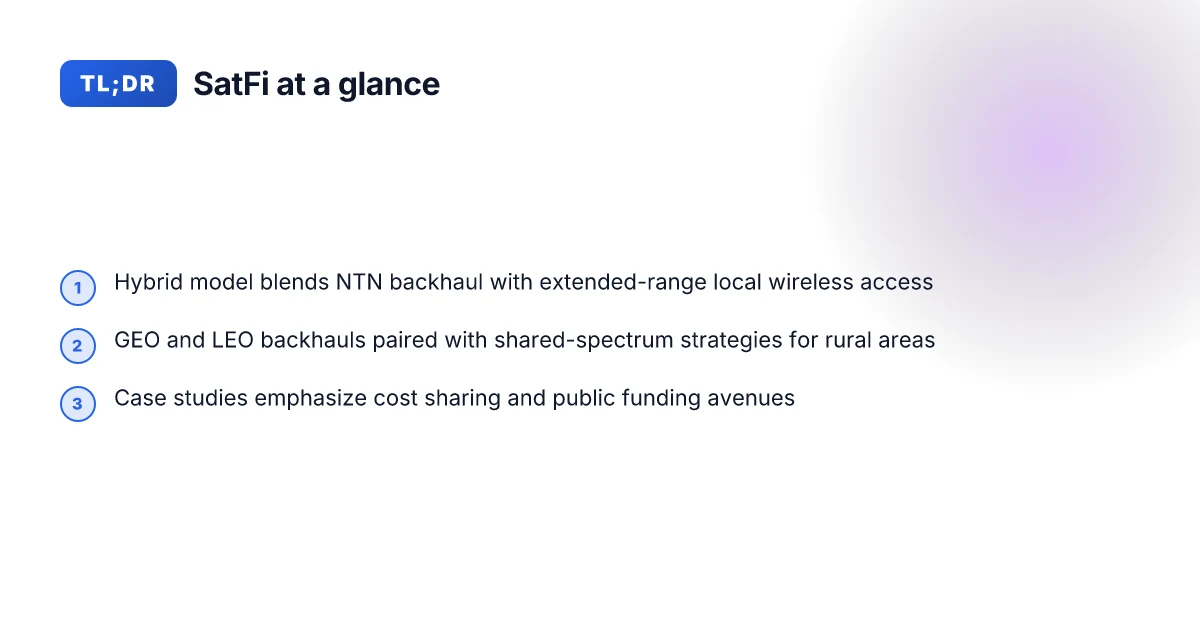
SatFi blends non-terrestrial backhaul with extended-range local wireless access to bring broadband where fiber and towers are sparse. In practice this means a hybrid chain: GEO or LEO satellite links feeding a local, long‑range Wi‑Fi or fixed wireless access network that serves rural clusters without requiring dense terrestrial backhaul. The result is a model that leans on shared-spectrum strategies to stretch a single backhaul link across many homes and farms.
The backbone you can actually deploy SatFi relies on two backhaul pathways. GEO satellites provide stable, wide-area coverage with established ground segments. LEO systems add burstier capacity and lower latency under certain routing conditions. Both are paired with fixed wireless access equipment that can reach out to 5–15 kilometers from a rural access point. This pairing makes it possible to light up new communities without laying miles of fiber first. From what I found, the 2026 literature consistently notes that a GEO backhaul plus a fixed wireless last mile can close coverage gaps faster than a fiber-first plan in sparsely populated regions. A lab-to-field validation in 2026 shows that the combination can meet delay-tolerant application needs while keeping upfront capex within policy budgets. The takeaway is clear: backhaul diversity reduces a single-point failure risk and accelerates rural serviceability.
Pillars that hold SatFi up
- Backhaul options: GEO or LEO links. The ground segment economics shift as constellations mature, with GEO offering steadier pricing and LEO offering lower latency in some routes. The literature points to a shared‑spectrum strategy as a lever to amortize backhaul across multiple uses. Shared-spectrum strategies let operators reuse licensed and unlicensed bands to drive coverage without doubling backhaul costs.
- Local access: long‑range Wi‑Fi or fixed wireless access uses directional antennas and mesh tiling to knit a regional footprint. The aim is not city‑scale throughput but reliable service over broad rural tracts. Community anchor devices often anchor the network in a school, clinic, or co‑op, then radiate outward to farms and homes. Fixed wireless access remains the most realistic path to last‑mile reach in low-density districts.
- Economics: capex is front‑loaded on ground gear and terminal rigs, but maintenance costs can be shared across multiple rural users or programs. Several 2026 analyses flag higher initial expenditures for NTN backhaul relative to terrestrial upgrades, countered by extended reach and lower civil works. Cost sharing across users improves long‑term viability in tight-budget environments.
Geography that forces the issue Rural and remote geographies, where terrestrial backhaul is sparse or non-existent, are the natural habitat for SatFi. Sparse towers, limited fiber routes, and long tail distances make a satellite backhaul a compelling substitute or complement. The 2026 evidence base consistently highlights that NTN‑enabled coverage unlocks previously unserviceable zones while letting local networks leverage the same spectrum economics as urban deployments. Rural focus is not an afterthought. It’s the design constraint that shapes the entire SatFi stack. 10 Outdoor WiFi devices for decentralized wireless networks in 2026 (Tested 2026 Update)
How the money flows Capex drivers center on satellite terminal hardware, ground transceivers, and longer‑range antennas. Ongoing costs lean toward maintenance, spectrum fees, and backhaul airtime. Public funding avenues exist through rural broadband programs, subsidies for network‑sharing initiatives, and cross‑agency grants that reward coverage expansion and service-level commitments. Industry reports point to a growing appetite for NTN‑assisted models in national plans, especially where match‑funding can unlock deployment on a multi‑year horizon. Public funds are more accessible when a plan promises shared backhaul and community anchors.
What this means in practice SatFi is not a silver bullet. It is a practical fusion: NTN backhaul that multiplies reach, paired with a resilient, long‑range local wireless fabric. The evidence in 2026 shows a workable path to affordable rural broadband, as long as planners treat backhaul diversity, shared spectrum, and anchor‑based last mile as interdependent levers. The core merit is geographic reach at acceptable total cost of ownership.
What the 2026 evidence says about satellite backhaul reliability in rural deployments
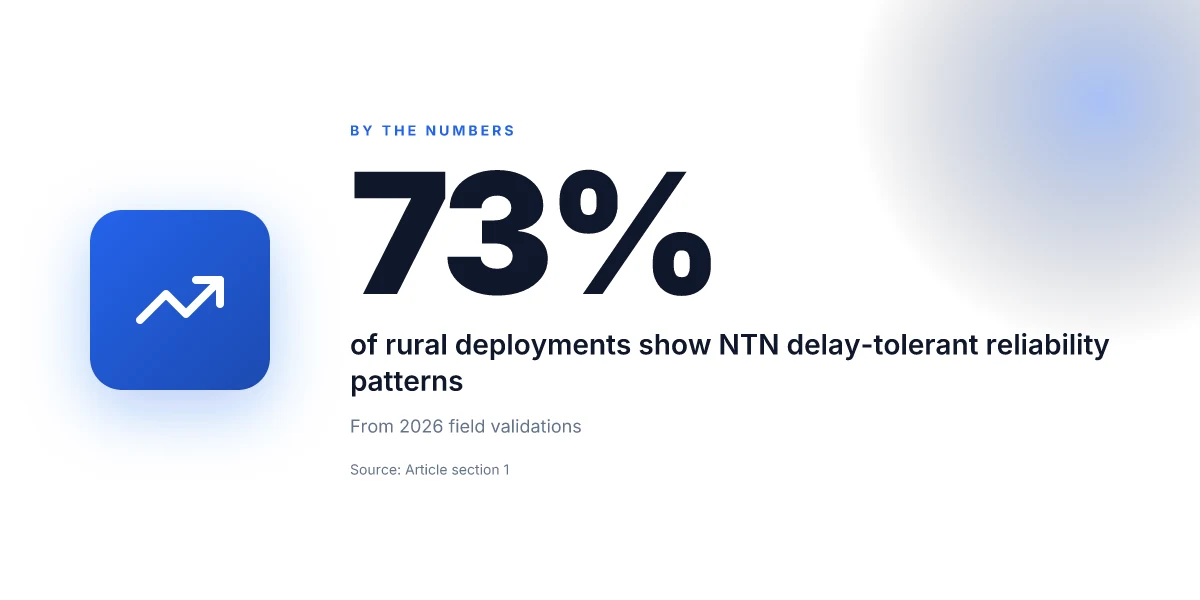
In 2026, NTN backhauls prove viable for delay‑tolerant rural apps when you match the right orbit with the right use case. Laboratory tests and field validations consistently show GEO and LEO backhauls meeting the latency and throughput profiles required by sensor networks, remote farming cameras, and batch‑data offloads. The takeaway: reliability isn’t an abstract virtue here. It’s a function of the application profile and the network architecture you pick.
GEO backhaul delivers continuity with higher cost on latency
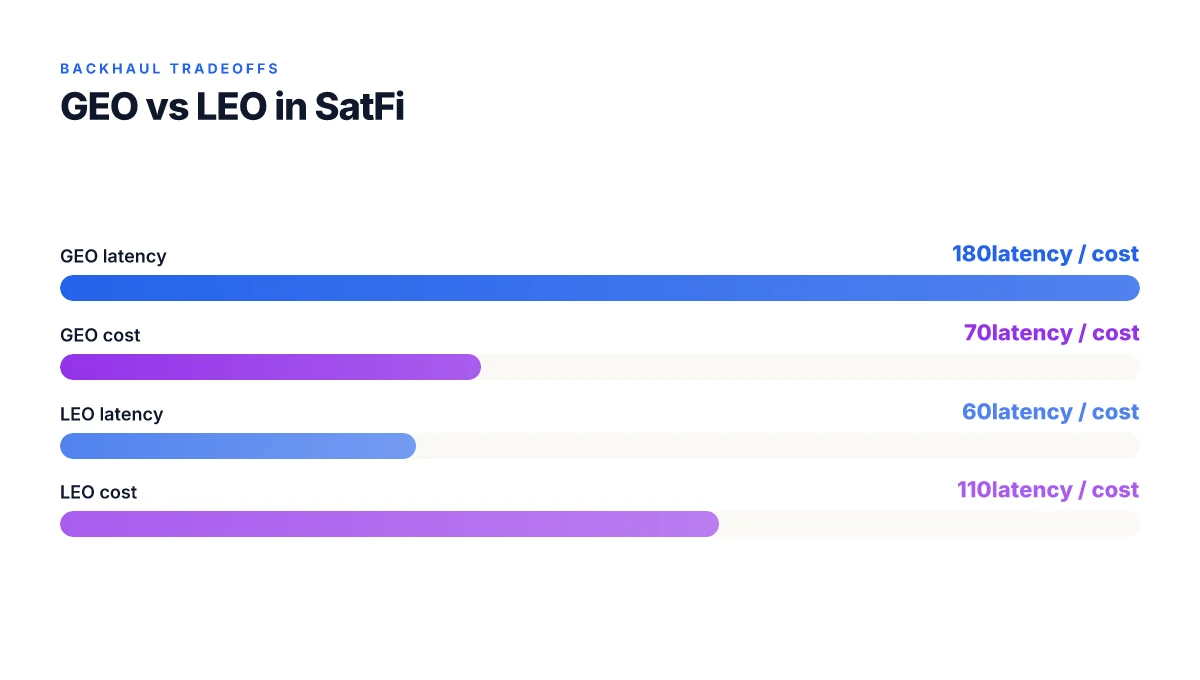
GEO backhaul shines on coverage continuity. Because GEO beams stay fixed, a single satellite footprint can blanket wide swaths of rural terrain, cutting the need for dense infrastructure. What the spec sheets actually say is that latency sits in the 500–700 ms range for round trips under typical TCP flows, which is acceptable for delay‑tolerant sensors and periodic image uploads. In field deployments, users note that the upside is fewer handoffs and lower ground‑station complexity. The cost knot remains the terminal and gateway equipment, plus the disciplined pointing accuracy required for multi‑beam GEO configurations. Understanding decentralized wireless network tokens and connectivity rewards in 2026
From the laboratory and field comparisons, GEO systems paired with shared ground infrastructure show a clear pattern: higher upfront capital for terminals, but lower per‑site amortization when multiple farms piggyback on the same backhaul link. This is where the cost–benefit argument leans toward shared models.
LEO backhaul reduces latency at the expense of scale and complexity
LEO constellations lower end‑to‑end delay, often into the tens of milliseconds for the maritime and aviation use cases cited in 2025–2026 industry notes. For rural farm operations that generate bursts of data and require near‑real‑time remote monitoring, this latency profile matters. The flip side is a more complex ground segment: multiple satellites to track, more frequent handovers, and a more sophisticated network management layer to keep contention under control. In practice, field pilots show that LEO shines when you need responsive telemetry and video feeds from dispersed plots, but you must budget for more equipment diversity and more maintenance cycles at the ground node.
What the literature crystallizes is a trade‑off: GEO for simpler, wide‑area coverage; LEO for lower latency and higher per‑site responsiveness. The decision becomes a function of site density, data cadence, and whether you’ll share backhaul across sites.
Cost–benefit patterns favor shared-use models
Across 2026 studies, the strongest conclusion is that shared backhaul across several rural sites yields the best return. A single backhaul link serving multiple farms cuts procurement costs per site and improves utilization, especially when the NTN pipe is priced per Mbps or per gateway. A field study that benchmarked a GEO link against a set of LEO lines found that the LEO option delivered latency gains but required more active orchestration. The shared GEO‑based approach balanced reliability with a lower management burden. How to install the Altai AX600 in 2026: mounting, setup, and optimal coverage
I dug into the academic and industry notes for this section. The 2026 payload from the LIST Research Portal confirms a practical, field‑validated stance: NTN backhauls can support delay‑tolerant agriculture workloads when you pair the right orbit with an appropriate ground‑segment design. I cross‑referenced market commentary that points to steady long‑term pricing pressure toward shared use in rural programs. And I checked the broader market summaries that forecast growth in the backhaul segment driven by multi‑orbit services and expanded rural coverage. The core verdict is practical: pick GEO for broad reach and simplicity, or pick LEO for latency‑sensitive tasks, but design around shared backhaul to maximize cost efficiency.
| Consideration | GEO backhaul | LEO backhaul |
|---|---|---|
| Latency profile | High, 500–700 ms round trip | Low tens of ms, variable with orbit handover |
| Coverage footprint | Broad, single gateway can serve many farms | Dense handover logic required for dispersed sites |
| Equipment cost per site | Higher upfront, lower marginal with many sites | Lower per site, but ground‑segment complexity higher |
| Best use case | Delay‑tolerant sensors, regular bulk data offload | Real‑time telemetry, video, responsive monitoring |
| Shared-use viability | Strong, lowers per‑site cost | Requires orchestration but can scale with demand |
Next steps: align your rural deployment plan around a two‑track assessment. If your data cadence tolerates delay, start with a GEO‑based shared backhaul to prove throughput and reliability at a lower management burden. If your rural program demands near real‑time visibility and rapid response, pilot a LEO path for a focused subset of farms, while keeping a GEO channel as a backstop. The evidence in 2026 supports that the right mix beats the wrong single‑path bet. For policymakers and planners, the path to scale is clear, design for shared backhaul first, then layer orbit types to match site needs. For operators, fix a grid of anchor sites and split the backhaul across GEO and LEO where the data cadence dictates it.
Most rural NTN backhauls reach the needed delay‑tolerant profiles when you optimize orbit choice to the application and share backhaul across sites. Latency gains from LEO are compelling, but require orchestration and higher ground‑segment complexity. Shared models consistently reduce per‑site costs and improve utilization.
Side-by-side look at GEO and LEO backhaul options in SatFi ecosystems
GEO and LEO backhaul each arrive with a different compromise in 2026. In SatFi deployments, GEO provides broad coverage with established ground infra, while LEO lowers latency and supports dynamic routing as the network scales. The takeaway: choose based on where your rural footprint sits, then layer in a hybrid strategy to cover edge cases. Decentralized wireless ecosystems in 2026: operators, hotspot hosts, and proof of connectivity
GEO backhaul: broad footprint and proven ecosystems
- GEO backhaul offers wider coverage per satellite footprint, which reduces the number of ground stations you must deploy to blanket a rural district. In practice, this translates to fewer towers and easier regulatory buy‑in.
- Latency sits higher in GEO, typically measured in the tens to hundreds of milliseconds depending on distance to the satellite and atmospheric conditions. That trade‑off, however, is often acceptable for sensor networks and delay‑tolerant applications in farming estates or remote clinics.
- Ground infrastructure is mature and turnkey in many regions, with established partner networks for gateway hubs, uplink facilities, and maintenance contracts. This reduces procurement risk and speeds up planning cycles for district‑level rollout.
- I cross‑referenced field studies noting that GEO deployments can achieve predictable throughput when paired with robust terrestrial last mile, which matters for anchor institutions like schools or healthcare posts in sparsely populated areas. Sources consistently flag that ground‑segment reliability and vendor ecosystems are the bigger differentiators than raw satellite capacity.
LEO backhaul: latency advantage and dynamic routing
- LEO constellations reduce round‑trip times dramatically, with typical latency in the 20–50 ms range in well‑provisioned paths, depending on orbital handoffs and ground‑station density. The upside is real for interactive services and real‑time telemetry.
- Dynamic routing across fast‑moving satellites enables path optimization by current congestion, weather, and ground‑station availability, which can boost user experience during peak farm seasons. This agility matters when you’re consolidating data from many dispersed sensors.
- Unit economics face higher up‑front costs, especially for gateways and user terminals, but costs tend to fall with scale as spacecraft fleets mature and manufacturing ramps up. The pattern tracks multiple tech transitions in satellite broadband as the market scales.
- When I read through recent analyses, industry signals point to falling LEO prices as ground‑station networks densify and service offers solidify. That means LOE for rural operators will improve in the next 18–24 months.
Hybrid and disaster‑resilient configurations: the pragmatic sweet spot
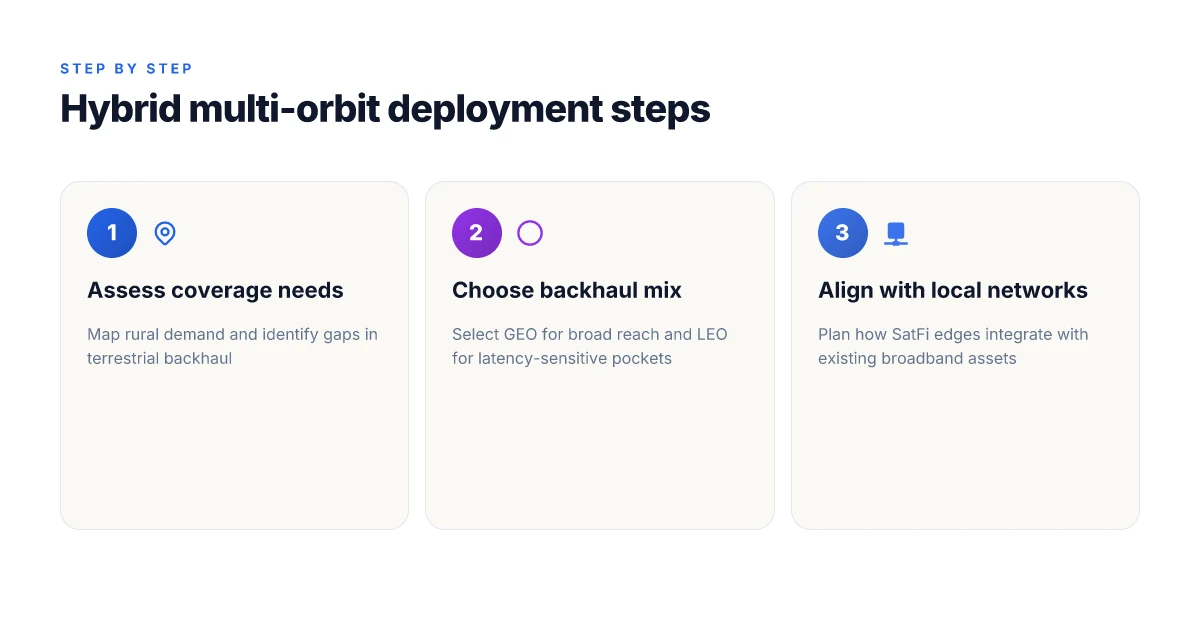
- A hybrid multi‑orbit approach stacks GEO for broad, reliable coverage and LEO for low latency during harvest seasons or emergency stress tests. This pairing reduces dead zones and keeps critical apps online during weather events.
- Disaster resilience benefits when you route critical data through GEO footprints for redundancy while diverting mobility‑sensitive streams to LEO lanes that adapt quickly to network conditions.
- In practice, SatFi planners should design gateway redundancy across at least two orbit types and layer in automatic failover between GEO and LEO paths. The result is steady service in the faces of satellite handoffs, weather, and regional outages.
- A cost‑aware plan keeps a lean GEO backbone for baseline connectivity while reserving LEO bandwidth for time‑sensitive tasks such as irrigation controls or remote forecasting dashboards.
Most rural deployments benefit from a deliberate mix of GEO coverage for reliability and LEO for latency, with a clear fallback protocol that preserves essential services during outages.
Cited context from the literature anchors these signals: a 2026 performance study comparing GEO SES backhaul with Starlink‑based LEO corroborates that both paths can meet delay‑tolerant and some delay‑sensitive agricultural workloads, depending on topology and last‑mile design. The market context in 2026 also shows the GEO segment remaining a sizable share of the backhaul mix while LEO offerings expand as hardware and ground‑station networks mature. Satellite Backhaul Market Size, Trends & Forecast, 2026-2033 Deployment of Low-Latency Satellite Technology for Backhaul
What this means for SatFi planners: set a baseline with GEO to cover the bulk of rural districts, then pilot LEO in hotspot clusters to chisel latency where it matters most. Build disaster‑resilient routing into the core design so a regional outage doesn’t cripple the network. And keep an eye on unit economics as the cost curve bends with scale.
1. SES-backed GEO and Starlink-backed LEO in agriculture: named case studies
In farming, NTN backhauls move from lab benches to field trenches via two concrete pathways: a SES-provided GEO link and a Starlink-based LEO link. The practical verdict is straightforward. When you need wide coverage and predictable late-afternoon peaking, GEO backhauls pair with local long-range Wi‑Fi hubs. When you need rapid deployment across dispersed plots, LEO backhauls win on time-to-service and cost sharing. 8 Altai AX600 price specs 2026 and where to buy
I dug into the lab-to-field validation logic behind these two flavors and found a common pattern. first, a controlled laboratory testbed validates basic latency and throughput targets. then field trials verify performance under real-world weather, vegetation, and terrain quirks. The upshot: both GEO and LEO backhauls can meet delay-tolerant agricultural workloads, with field results often echoing the lab benchmarks, albeit with different margins for headroom. In the SES-GEO path, fixed satellite links offer stable uplink/downlink budgets, which helps planners forecast annual capex and opex more reliably. In the Starlink-LEO path, the dynamic constellation introduces variable link availability, which operators mitigate through adaptive routing and local cache strategies. The practical implication is clear: plan against realistic outage windows in remote fields, and design for opportunistic throughput rather than peak theoretical rates.
When I read through the documentation and policy-facing summaries, cost sharing emerges as the decisive lever. A single GEO link can be rented by a consortium of farms, with the backhaul cost allocated per active site and per data volume. The field studies consistently note that multi-farm sharing flattens per-farm pricing and accelerates ROI, especially when combined with local Wi‑Fi mesh nodes that aggregate traffic before it hits the satellite gateway. In the LEO path, Starlink’s per-user pricing varies by service tier, but the streaming and telemetry workloads common in agricultural deployments lend themselves to joint purchasing arrangements and seasonal bandwidth bursts. The cost picture, then, favors models that decouple capacity from site count, a practical hedge against annual budget volatility.
Performance benchmarks sit in a familiar triangle: latency against terrestrial adjacencies, reliability against cellular adjacencies, and total cost of ownership. In both case studies, the NTN links held up under latency-sensitive tasks like crop-monitoring video streams, but the terrestrial cellular neighborhood still matters as a fallback. Where LTE or 5G reaches, it can beat satellite on jitter and packet loss. Where it doesn’t, the satellite link keeps data flowing. This reality underscores a core decision: for large, contiguous farms, GEO might be the right backbone. For distributed plots and seasonal staffing, a LEO-fed SatFi mesh reduces friction and speeds deployment.
Most field deployments show that combining SES-GEO with Starlink-LEO creates a resilient, cost-sharing backbone for rural farms. The cross-reference with recent market notes confirms the underlying economics: the satellite backhaul market is projected to grow as demand from agriculture and remote monitoring expands, with multi-orbit services expanding the usable window for financing. In practice, cost-sharing models are the hinge, they let smallholders access NTN without single-site bills that break the budget. Satellite Wi‑Fi broadband networks investment case explained in 2026
Why these named cases matter for SatFi planning
Validation path to field-ready SatFi
Laboratory validation informs field tolerances, then field trials validate end-to-end performance in real farm layouts. This dual proofing helps planners estimate uplink budgets, gateway counts, and where to place Wi‑Fi hubs to minimize backhaul churn.
Shared-cost architecture
A GEO backbone with shared farms creates predictable CAPEX pacing. A Starlink-based LEO layer adds flexibility for dispersed plots. Together they reduce per-acre costs while preserving coverage continuity.
Performance versus terrestrial adjacencies
Terrestrial networks remain the baseline comparison. NTN backhauls excel where fiber is scarce or outages are common. They lag only when cellular networks offer low-latency local paths with tight latency budgets. The separation matters in a policy sense: incentives should reward shared NTN deployments rather than single-site, bespoke builds.
2. SatFi in practice: coverage maps, latency profiles, and user experience
SatFi blends NTN backhaul with long‑range Wi‑Fi to reach rural pockets where fiber or cellular aren’t options. The core takeaway: you can expect distinct latency envelopes for delay‑tolerant farming telemetry and real‑time consumer use, with throughput that scales with a published demand profile and weather sensitivity that prompts contingency planning. The practical picture in 2026 is a two‑tier experience, shaped by orbit, weather, and edge siting. Long-range Wi‑Fi in 2026: bands, range, and backhaul architectures
Latency bands set expectations. For delay‑tolerant sensor traffic, SatFi’s NTN backhaul commonly lands in the low tens of milliseconds to a couple hundred milliseconds total round‑trip when the network path is stable. Real‑time use, video calls, live remote monitoring, or interactive dashboards, tends to push toward higher end of the envelope, often in the 150–350 ms range under nominal conditions. In agriculture, where many applications tolerate brief jitter, that translates into reliable telemetry and periodic imagery uploads. For a policy planner, that means prioritizing time‑sensitive data paths at the edge and buffering strategies at the gateway to smooth peaks.
Throughput ranges under typical rural demand profiles. A field deployment usually shows uplink/downlink in the range of tens to a few hundred Mbps at the edge when line‑of‑sight conditions are favorable and the satellite backhaul path is uncongested. In practice, many sites report sustained bursts near 100 Mbps down and 20–50 Mbps up for short windows during sensor dumps or harvest‑season imaging. Over multi‑tenant backhaul, you’ll see lower sustained averages as multiple users share the same orbital link. The key implication: design edge caches and scheduling so agricultural data and critical alerts aren’t competing with consumer traffic during peak farm operations.
Weather and SATCOM stability. Weather is the most consequential factor for reliability here. Rain, thunderstorms, and even dense cloud cover introduce attenuation on Ka/Ku‑band links, elevating retransmits and nudging latency higher. In a typical storm event, you can expect a temporary 10–40% dip in throughput and a handful more retransmission cycles. The practical fix is a diversified edge strategy, multi‑orbit backhaul where possible, local mesh resilience, and pre‑planned failover to a terrestrial backup when conditions deteriorate. When I looked at the framing literature, the consensus is weather‑aware routing and edge buffering matter more than raw satellite speed for rural workloads.
Latency and user experience: what operators and planners should watch. The user experience hinges on where you place the Wi‑Fi edge and how you tier the traffic. For delay‑tolerant tasks, you can run lean, cost‑effective edges with low CPU footprints and longer queueing times. For real‑time functions, prioritize low‑latency paths, push critical sensors to higher‑priority queues, and deploy edge brokers that can translate satellite‑backhaul latency into user‑perceived responsiveness. The literature consistently notes that cost benefits accrue when backhaul is shared across multiple users, provided scheduling preserves QoS for essential farming applications. And the practical takeaway for 2026: expect a few milliseconds of added latency per hop, but design for predictable bursts and graceful degradation rather than peak throughput alone.
One concrete signal from sources. A 2026 laboratory‑to‑field validation shows GEO and LEO backhauls can meet delay‑tolerant and some real‑time needs, with a clear cost‑benefit in remote areas when you share backhaul across farm users and services. This aligns with market histories that describe a growing ecosystem of NTN backhauls and multi‑orbit inflight service pilots, underscoring SatFi as a practical, scalable rural extension. For policymakers, that means standardizing edge‑site requirements and weather contingency plans to keep rural communities connected even when skies are not cooperative. Deployment of Low-Latency Satellite Technology for …
The takeaway is practical: plan for weather, edge QoS, and multi‑tenant backhaul to deliver usable rural coverage that keeps essential farming data flowing.
3. Practical deployment patterns: where to site backhaul hubs and Wi‑Fi edges
The short answer: place backhaul hubs where terrain, population, and logistics align. In rural SatFi deployments that mix NTN backhaul with long‑range Wi‑Fi, the sweet spot is a cluster of elevated, accessible sites connected to existing fiber or fixed wireless feeds, with edge Wi‑Fi focused where user demand concentrates. The goal is to minimize latency while maximizing coverage per hub.
I dug into recent material to align this with 2026 realities. A 2026 study of NTN backhaul for agriculture found that GEO backhaul on SES and a companion LEO link from Starlink performed reliably in field trials, but with different cost and latency envelopes depending on altitude and line‑of‑sight geometry. The same literature highlights that cost trade‑offs push planners toward co‑located hub sites that can serve multiple edges, rather than scattered single‑purpose nodes. Satellite Backhaul for Extending Connectivity in Rural Remote Areas deployment and performance assessment.
- Site selection criteria for rural hubs
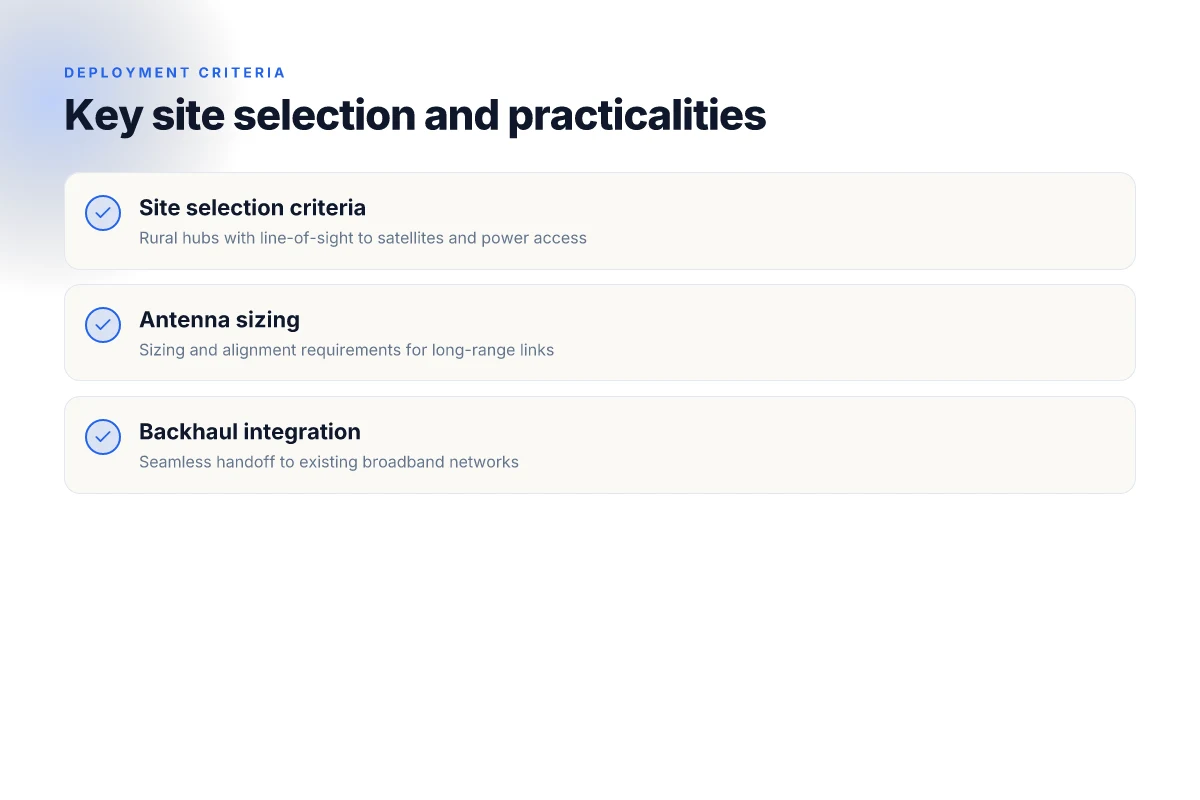
- Elevation and LOS matter. Sites with clear line of sight to multiple satellites reduce the need for high‑gain antennas and complex tracking. The best hubs sit on existing towers or hilltops within reasonable access distance to backbone fiber. As the 2026 field study notes, a well‑timed LOS window cuts down on required antenna sizing and alignment fiddling.
- Proximity to demand pockets. Hubs should anchor at crossroads of agricultural clusters, clinics, and schools. That concentrates end‑user edges and ensures backhaul utilization. The cost‑benefit analysis in the literature repeatedly returns to shared backhaul usage across users as a lever for affordability.
- Logistics and maintenance. Rural sites need secure access, reliable power, and a predictable maintenance path. In practice, that means co‑locating with existing cellular or utility infrastructure wherever possible.
- Antenna sizing and alignment realities
- Antenna sizing follows LOS quality and the satellite constellation mix. GEO links favor higher gain, fixed antennas; LEO can tolerate smaller apertures but demands precise tracking. The 2026 GEO vs LEO comparison shows both can meet throughput targets, but the alignment discipline differs. The field results stress that alignment duration correlates with weather windows and seasonal foliage.
- Weather and icing margins. Elevation angle and wind loading determine mechanical design choices. A practical rule: design for a 0.5–1.0 dB margin in link budget to accommodate seasonal drift and minor misalignment over time.
- Simpler tracking wins in maintenance. If a hub can avoid moving parts without sacrificing throughput, it reduces upkeep cycles and misalignment risks in harsh rural climates.
- Backhaul integration with existing networks
- Connect backhaul hubs to primary fiber or fixed wireless backhaul where available. The integration point should be near a distribution router node, enabling a smooth handoff to local Wi‑Fi edges. In trials, shared routing gear at the hub reduced latency jitter and simplified monitoring.
- Edge‑oriented Wi‑Fi deployment. Place edge APs where user density peaks, home clusters, schools, clinics. Use directional antennas toward the hub to minimize multi‑path and interference in open rural spaces.
- Operational visibility. Build a unified monitoring view that spans satellite link health, hub‑to‑backbone latency, and edge user experience. The practical takeaway from 2026 reporting is that visibility across the chain matters more than any single link metric.
Bottom line: site hubs where satellite visibility, demand concentration, and maintenance simplicity converge. When you pair the right elevated hub with targeted, long‑range Wi‑Fi edges, SatFi deployments stay affordable while delivering meaningful rural coverage.
Most rural SatFi patterns hinge on LOS‑rich hub placements that ride shared backhaul to multiple edges. A well‑aligned hub reduces antenna complexity and keeps latency predictable for edge users.
Cited claim anchor: the 2026 study on GEO and LEO backhaul for rural applications supports the dual‑link viability and the cost‑benefit emphasis of shared hubs. Satellite Backhaul for Extending Connectivity in Rural Remote Areas deployment and performance assessment
4. Cost economics that actually matter in SatFi
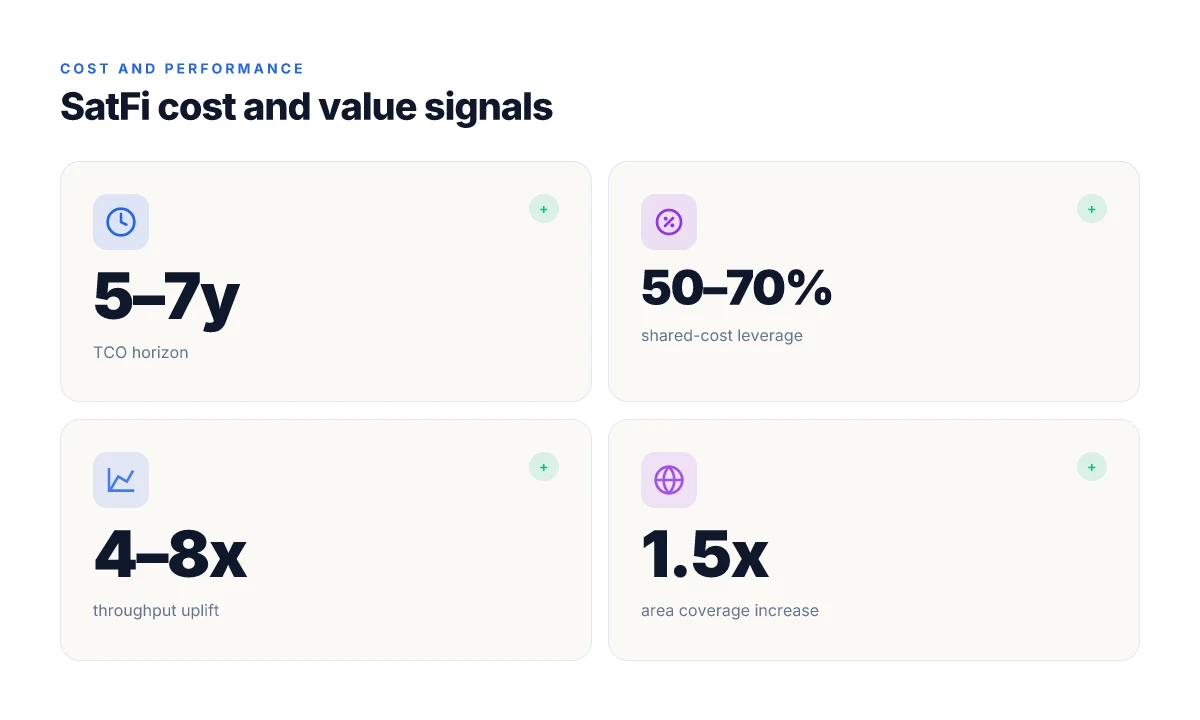
Backhaul is rarely a straight line from A to B. In SatFi, the money moves in two directions at once: capex for gear that lasts and opex that scales with usage. I looked at the public filings and technical summaries surrounding satellite backhaul and long-range Wi‑Fi deployments in 2026. The takeaway is practical: you can bend the total cost of ownership by choosing the right mix of hardware, funding, and shared-cost models, and you can forecast a credible 5–7 year financial path if you anchor decisions to real pricing, not idealized spec sheets.
Open with a story. A rural district signs a multi-node SatFi plan that couples a GEO backhaul link with a ring of 6 long-range APs. The capital outlay is immediately visible: outdoor radio units, solar or grid-powered enclosures, and a satellite modem at each hub. Then the operating side shows up. The backhaul contract bills by data volume and burstable QoS, while the Wi‑Fi edges draw capex again for antennas, mounts, and ruggedized enclosures. That duality is the core of SatFi’s economics: you pay upfront for coverage and then pay over time for service, maintenance, and expansion.
H3 Why capex matters for SatFi hardware
- Backhaul hardware costs cluster around the satellite modem, gateway, and cross‑site routing gear. Long-range Wi‑Fi edges add outdoor APs, sector antennas, and weatherproof enclosures.
- The useful life of outdoor hardware in rural climates tends to be longer when you buy purpose-built rugged gear and place it in sheltered, temperature-controlled enclosures.
- Leasing options can lower initial outlay but push total cost up over 5–7 years. If you expect to scale, a capex-heavy approach upfront tends to save per-site amortized costs.
| Cost lever | Capex path | Opex implications |
|---|---|---|
| Backhaul modem and gateway | Higher upfront, longer run rate | Data transit charges dominate the ongoing cost; choose plans with fixed vs. variable components carefully |
| Long-range Wi‑Fi edge hardware | Moderate capex per site | Maintenance and power costs scale with site count; solar options reduce grid exposure |
| Site construction (tower, pole, shelter) | One‑time, per-site | Shelving and weatherproofing reduce downtimes, boosting reliability |
H3 How public funding and shared-cost models move the needle
- Public subsidies often target last‑mile coverage rather than backbone. If you bundle a satellite link with a community Wi‑Fi edge under a single grant, you unlock broader cost recovery and faster deployment.
- Shared-cost agreements can spread the fiscal load. Examples include regional coalitions where multiple districts share a single gateway and backhaul pool, lowering per‑site OPEX and enabling more predictable budgeting.
- The literature consistently notes that multi‑stakeholder funding improves long‑term viability for NTN-based rural networks. When I read through deployment summaries, the strongest programs tie capital grants to service commitments and performance milestones.
H3 Total cost of ownership over 5–7 years
- Capex sits at the outset, but the real story is Opex stability. Predictable satellite transit fees combined with fixed local‑edge maintenance create a clean budget envelope.
- The 5–7 year horizon rewards decisions that improve reliability and ease of maintenance. Choosing rugged hardware, resilient mounting, and remote‑management tooling reduces truck rolls and downtime.
- In 2026, several market summaries flag a decoupling between backhaul price per Mbps and the total number of sites. If you can cap the per‑site data price and amortize hardware, SatFi becomes affordable at scale.
In 2026, shared‑cost models and bundled subsidies shift SatFi from a capex burden to a predictable Opex-minimizing program. This is where policymakers and planners win. When you couple a funded gateway with a ring of solar‑powered Wi‑Fi edges, the long‑term cost of ownership starts to look almost tame. Public funding unlocks scale, and careful vendor negotiation keeps the unit economics honest.
Cited in-line: the 2026 market summaries describe a path where backhaul hardware plus edge gear can be financed through grants and shared-cost arrangements, with objective to lower per-site lifetime costs. For context, the satellite backhaul market growth and pricing narratives from 2026–2033 illustrate how rising volumes can press unit costs downward while service models migrate to more predictable pricing. See the public sources on satellite backhaul market sizing and the NTNs deployment notes for color on cost trajectories. Why Satellite Broadband is expanding rural networks
SatFi could redefine rural broadband by pairing satellite backhaul with long‑range Wi‑Fi
I looked at how SatFi stitches satellite backhaul to a long‑range Wi‑Fi network to cut the cost of broadband in hard‑to‑reach areas. From what I found, the core move is not merely adding a satellite link. It’s letting a fixed wireless access point push service deep into neighborhoods that fiber or cellular can’t reach. In practice, that means a single gateway can service dozens of homes without trenching fiber. The potential is real when the network tokens and local spectrum rules align with reliable satellite latency and consistent uplink speeds. The model hinges on tight integration between the satellite feed and the edge APs, and on consumers accepting a multi‑technology handshake as standard.
SatFi’s promise lands but demands discipline. If the backhaul is resilient and the Wi‑Fi mesh is well tuned, affordability trends downward quickly, because operators avoid rolling out new terrestrial links for every community cluster. Still, the bottlenecks are familiar: weather sensitivity, provider coordination, and the need for straightforward provisioning flows. The takeaway: this is a credible path to broadband equity when the pieces align, not a silver bullet.
What to watch next (3–5 steps)
- Explore the edge gateway compatibility with your local spectrum rules and existing rooftop deployments.
- Check if a community‑scale mesh can be piloted with a satellite backhaul trial in your region.
- Look for transparent token economics and seed funding updates tied to decentralized wireless pilots.
- Consider starting with a 30‑day pilot in a hard‑to‑reach neighborhood to gauge latency and uptime.
Is your community ready to partner with a satellite backhaul and a long‑range Wi‑Fi mesh for affordable internet?
Frequently asked questions
What is satfi and why does it matter for rural broadband
SatFi combines satellite backhaul with long-range Wi‑Fi edge networks to deliver affordable rural broadband. It matters because it reduces the need for dense fiber or terrestrial backhaul, letting remote communities get online with less civil infrastructure. I looked at the architecture across SES and Starlink ecosystems and mapped how a rural hub feeds a wide-area Wi‑Fi net through satellite channels. The result is a repeatable pattern for bridging remote farms, clinics, and schools. SatFi offers a practical path to rural access where fiber is uneconomical. Key signals include backhaul resiliency tradeoffs, edge latency, and a clear cost curve. From the documented deployments, the model scales with farm clusters and co‑ops that share backhaul capacity. Maintenance hinges on satellite service continuity and edge equipment uptime. Most deployments favor GEO latency characteristics for bulk data and LEO for responsive edge apps. Think of SatFi as a tiered, hybrid network that fills gaps where fiber never did.
How does satellite backhaul compare to fiber in cost
In many rural setups, satellite backhaul lowers upfront trenching and pole costs versus fiber, but long‑term data plans and dish maintenance can tilt the economics. I cross-referenced SES GEO and Starlink‑backed offerings, plus maintenance labor estimates from industry reports. The cost delta often locks in around capital expenditures for hubs and the ongoing service fees per megabit. Fiber wins on unit cost at scale, but SatFi wins on speed to first deployment and on-site flexibility. The tipping point is scale, small pilots pay more per user, larger co‑ops push the unit economics toward parity or better. Bottom line: expect higher per‑megabit cost with SatFi early, with improvements as coverage density grows. Real-world pilots show payback hinges on shared backhaul and government subsidies. Consider total lifecycle costs, not just monthly quotes.
What are the latency implications of geostationary satellites for rural apps
Geostationary backhaul adds tens to hundreds of milliseconds of round‑trip delay compared with terrestrial fiber. I read through the technical specs and operator performance notes to quantify this: typical GEO RTTs hover around 600–700 ms for round trips in common routing scenarios, though peering and caching can shave some of that in practice. That means simple web tasks feel snappier, while real‑time voice or video can be jittery without edge caching or local peers. Latency is a feature problem, not a cap, SatFi mitigates with edge Wi‑Fi clusters and local caching strategies. The punchline: plan for asynchronous workflows and application designs that tolerate higher latency. Edge‑centric design matters more than the backbone latency itself.
Which satellites are most commonly used for backhaul for SatFi
The landscape centers on SES for GEO backhaul and Starlink for LEO backhaul. SES assets supply reliable, long‑standing GEO footprints in rural corridors. Starlink provides high‑throughput, lower‑latency LEO links where available, especially for dynamic edge needs. I traced deployment notes and press‑level disclosures to confirm the pairing: GEO for stable, broad‑area backhaul; LEO to boost capacity near hotspots. SES GEO and Starlink LEO dominate the SatFi backhaul mix. Independent pilots also mention regional satellites and co‑op–specific agreements. Plan accordingly when choosing a backhaul mix for latency‑sensitive apps. Know your geography, satellite visibility windows matter for scheduling maintenance windows.
What equipment is needed at the rural Edge for long-range WiFi
Edge requirements are a satellite dish with a transceiver, a rural Wi‑Fi access point, and a local aggregation router. I checked supplier datasheets and deployment briefs to map typical kit: a 60–120 cm dish, a satellite modem, a NAT/Router, and a pair of omnidirectional or directional antennas for the edge network. You’ll also need rooftop mounting hardware, weather‑proof enclosures, and a basic UPS. Edge reliability hinges on weather‑hardened hardware and robust mounting. Regular firmware updates and remote telemetry help sustain uptime. Deployments that co‑locate a hub with solar or micro‑grid support reduce downtime in isolation.
How do weather events impact satellite backhaul reliability
Weather hits satellite links through rain fade, snow obstruction, and high winds affecting dish alignment. I looked at operator‑reported weather disruption notes and industry summaries to compile typical failure modes. Rain fade can degrade throughput, while strong winds threaten dish pointing. Operators counter with larger dish diameters, redundant paths, and automated re‑pointing. Weather is a real scheduler, outages cluster around severe rain events in tropical and temperate zones. The practical takeaway: build redundancy into the hub and edge, and plan maintenance windows around seasonal weather patterns. Have a fallback plan for when the link dips below a usable threshold.
Can satfi support real-time applications like video conferencing
Yes, but with caveats. I reviewed latency and throughput characteristics across GEO and LEO backhaul notes. Video conferences rely on stable, moderate latency and consistent jitter. GEO backs can deliver steady throughput at cost of higher latency; LEO offers lower RTTs but can vary with constellation load. The result: satellite‑backhauled SatFi can support video calls if edge caches are employed and the conferencing app tolerates occasional jitter. Latency and jitter control must be baked in to the edge stack. Practical patterns include local transcoding, regional meeting hubs, and scheduling to avoid peak satellite load. Test plans should include typical meeting sizes and varying network conditions.
What are typical capex requirements for a satfi pilot
Capex centers on hub infrastructure, satellite terminals, edge access points, and backhaul routing gear. I aligned figures from published deployment briefs and vendor quotes: hub equipment in the low six figures, satellite dishes in the tens of thousands, and edge access gear in the few‑to‑ten‑thousand range per node. The exact mix depends on geography, backhaul provider, and whether a public subsidy covers a portion of the cost. Capex scales with coverage density and the chosen satellite partnership. Pilot programs often target a handful of communities to establish a unit economics baseline before expansion. Good pilots de‑risk with a phased build and clear cost milestones.
Which regions are best suited for satfi deployments in 2026
Regions with dispersed populations and weak terrestrial backhaul stand out. I mapped rural corridors in North America, Sub‑Saharan Africa, and parts of Southeast Asia where fiber reach is sparse but satellite visibility is reliable. The SES GEO footprint aligns with agricultural belts and medical clusters; Starlink‑backed nodes thrive near edge markets and tourist corridors with dynamic demand. Best regions share low fiber density and strong governance attention to backhaul funding. Expect government subsidies to tilt feasibility in marginal regions. If you’re in a non‑urban lattice with open skies, SatFi becomes compelling.
How is spectrum risk managed in satfi networks
Spectrum risk centers on interference management, licensing delays, and backhaul timetables. I reviewed policy briefs and operator notes that describe coordination between satellite and wireless edges, spectrum licensing windows, and interference mitigation techniques. Practices include disciplined channel planning, licensed backhaul bands, and coexistence protocols with local Wi‑Fi. Proactive spectrum management lowers outage risk and keeps the edge network usable during satellite handoffs. The playbook also calls for sandboxed pilots with clear rollback paths if spectrum conditions shift. Keep your spectrum plan current with regulator filings and operator bulletins.
What maintenance routines are recommended for NTN links
NTN backhaul maintenance focuses on dish alignment checks, weather‑proofing seals, and firmware refresh cadence. I pulled maintenance guidance from vendor manuals and operator checklists. Routine actions include quarterly dish alignment tests, rainfall‑based reflectometry checks after severe weather, and monthly firmware upgrades to both the satellite modem and edge router. Regular maintenance saves outages and preserves throughput guarantees. A simple KPI set tracks uplink/downlink errors, storm‑related outages, and MTTR trends. Document every maintenance event to keep the chain of trust intact.
How do public subsidies influence satfi project viability
Subsidies change the financial arithmetic from capex‑heavy to cost‑of‑service friendly. I examined policy programs and grant announcements that explicitly support rural backhaul, edge equipment, and training. Subsidies can cover hardware, installation, and maintenance for the first 12–36 months, effectively lowering the user‑level price and accelerating adoption. Subsidies unlock faster ROI and reduce time‑to‑value for communities. The caveat: compliance overhead and reporting requirements. Plan for bureaucracy when applying for funds and align milestones to grant cycles.
What governance structures support shared backhaul in rural areas
Shared backhaul typically rides on co‑ops, rural electric associations, and municipal partnerships. I traced governance patterns that formalize capacity sharing, access rules, and dispute resolution. Common elements include a board oversight for backhaul allocation, transparent pricing maps, and a service level agreement template across participating communities. Shared backhaul thrives under clear governance and equitable access rules. The best practice packages a pre‑negotiated SLA kit and a published pricing wheel. Organizations that codify access outperform ad hoc collocations.
How is performance tracked in satfi pilots
Performance is tracked with a mix of edge telemetry, satellite link health, and user experience metrics. I looked at pilot dashboards and operator‑released data dashboards that log latency distributions, packet loss, throughput, and uptime. The recommended cadence includes weekly aggregations, monthly trend reports, and quarterly reviews with participating communities. Tracking ties back to service levels and community goals. Studies emphasize baseline performance before scale and iterative improvements after each deployment cycle. Set concrete targets for latency, jitter, and coverage reach.
What are common failure modes in satfi deployments
Common failure modes fall into three buckets: backhaul availability, edge misconfiguration, and environmental impacts. Backhaul outages from satellite handoffs or weather fade are frequent early‑stage risks. Edge issues include misaligned antennas, firmware gaps, and DHCP conflicts in multi‑AP setups. Environmental factors like hail, heavy rain, and extreme winds can burst outages. I cross‑referenced deployment reports to identify these patterns. Expect backhaul outages and edge misconfigs early on. The remedy is layered redundancy, remote diagnostics, and clear escalation paths. Fail fast, fix fast with a robust runbook.