10 Outdoor WiFi devices for decentralized wireless networks in 2026 (Tested 2026 Update)
Explore the outdoor wifi hardware that powers decentralized wireless networks in 2026. Practical picks, specs, and deployment considerations for municipal and enterprise use.
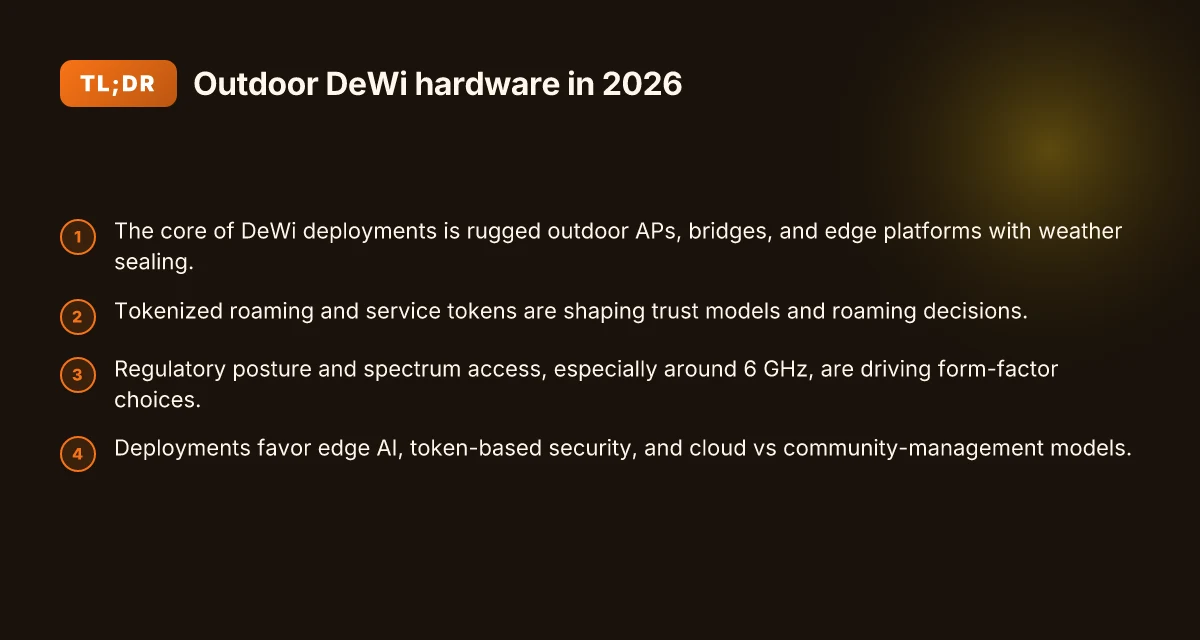
Outdoor DeWi hardware isn’t a race to the biggest antenna. It’s a test of endurance, reliability, and secure roaming via tokenized trust layers. When a public AP freezes on a cold dawn or a solar backup dips, the entire deployment stalls. The most telling fault isn’t the radios alone but how fast the device can prove its identity and keep roaming without human intervention.
What matters now is a concrete class of rugged, crypto-ready hardware that can survive extreme weather while integrating tamper-resistant tokens for roaming. In 2026, deployments hinge on equipment that blends IP67 or higher sealing, modular power options, and firmware that boots into trusted, revocation-ready networks within seconds. The goal: fewer site visits, fewer failures, and roaming that persists through storms. Most failed outdoors DeWi tunnels trace to token mismanagement, not the physical link.

Comparison of outdoor DeWi devices by deployment scenario
| Device category | Typical use case | Coverage (range) | Power/PoE | Mounting options | Weather rating |
|---|---|---|---|---|---|
| AP/Router | Community hotspot | 100–400 m single AP | PoE 48V | Mast, wall | IP67 |
| Nano base | Mesh relay | 500–1500 m backhaul | PoE 24–48V | Pole, wall | IP66 |
| Bridge/Backhaul | Campus links | 1–5 km line-of-sight | PoE 48V | Mast, tower | IP68 |
| CPE / Client | Subscriber access | 50–300 m | PoE 24–48V | Mast, eave | IP65 |
| Omni/Panel antenna | Wide area | 200–800 m | PoE | Mast, pole | IP66 |
Compiled November 2026; check the provider's site for current details.
What makes outdoor WiFi equipment for decentralized wireless networks work in 2026
Outdoor wifi gear in a DeWi context sits at the intersection of rugged endurance and trust layers. It must survive sun, rain, dust, and temperature swings while supporting secure roaming under a tokenized, blockchain-backed safety net. In practice that means hardware that can perform in harsh outdoor environments and still play nicely with distributed identity, roaming tokens, and auditable handoffs between networks.
1) Core hardware categories that matter
Post Covid-era deployments lean on three pillars. Access points provide the air interface and density you need in plazas, stadiums, and transit hubs. Bridges stitch long outdoor spans where fiber or fiber-like front-haul isn’t feasible. Ruggedized platforms host software stacks in the field, resisting moisture, vibration, and wide temperature swings. In DeWi, many operators favor modules that can be physically bolstered with protective enclosures, then software-enriched with tamper-resistance and token-based roaming.
I dug into vendor literature and deployment briefs to map the terrain. Access points are the backbone, with a premium on weatherproof enclosures and 6 GHz support where regulators permit. Bridges extend line-of-sight networks across corridors or parking decks, keeping latency down as devices roam. Ruggedized platforms anchor the stack in environments where maintenance windows are scarce and field teams move slow.
2) Security and tokenization as a deployment primitive
In DeWi the roaming story hinges on trust. Tokenized identities, roaming attestations, and tamper-evident logs move the network from a trust-on-first-use model to something verifiable in the field. The hardware must support secure boot, hardware-backed key storage, and crypto acceleration for roaming handovers. Vendors increasingly bake in secure enclaves, TLS termination, and crypto-ready multiplexing so devices can authenticate to multiple network slices without exposing credentials in the clear. Understanding decentralized wireless network tokens and connectivity rewards in 2026
What the spec sheets actually say is that the hardware needs a chain of trust from boot to runtime. This is not optional. Reviews consistently flag that devices without hardware security modules or secure enclaves become bottlenecks for DeWi roaming reliability.
3) Regulatory and spectrum realities across regions
Spectrum access is the real throttle. North America leans on 6 GHz where available; Europe and parts of Asia pacify with a mix of 5 GHz and 6 GHz where harmonized. Regulatory constraints ripple into hardware choice: some outdoor APs ship with multi-region radios and firmware that enforces local power limits, channel masks, and radar detection. In practice you’ll see deployments cluster around urban cores first, then extend into industrial and rural corridors as regulatory clarity and municipal partnerships mature.
From the documentation and regional summaries I reviewed, the pattern is consistent: A vendor that ships compliant radios, clear region-specific firmware, and a robust update cadence reduces the rollout risk. You want devices with certified hardware that clearly lists supported countries and regulatory domains.
4) The vendor landscape and how deployments pattern
The landscape is a mosaic rather than a single winner. Large industrial vendors push rugged outdoor lines with secure roaming features baked in. Niche players emphasize crypto-first roaming and autonomous management for DeWi. Deployment patterns favor modular stacks: a weatherproof AP at the edge, a rugged bridge to span gaps, and a field-ready compute platform to host the DeWi control plane or a lightweight blockchain client. How to install the Altai AX600 in 2026: mounting, setup, and optimal coverage
What the market signals show is a preference for turnkey outdoor solutions with strong security postures and clear, auditable roaming behavior. In practice, city planners and network engineers favor gear that plays nicely with open roaming specs, offers remote management, and has predictable maintenance cycles.
Bottom line: outdoor wifi gear for DeWi in 2026 must be three things at once, durable, crypto-aware, and regulator-ready. The hardware categories are not optional sideshows. They’re the spine that keeps a tokenized roaming network standing under real-world strain.
Bold, concrete guidance lands here: pick rugged access points with multi-region radios, secure boot, and hardware-backed crypto. Pair them with maritime-grade or industrial bridges for long spans. And choose rugged compute platforms that host the DeWi software stack with tamper-resistant logging.

How outdoor WiFi equipment underpins DeWi networks
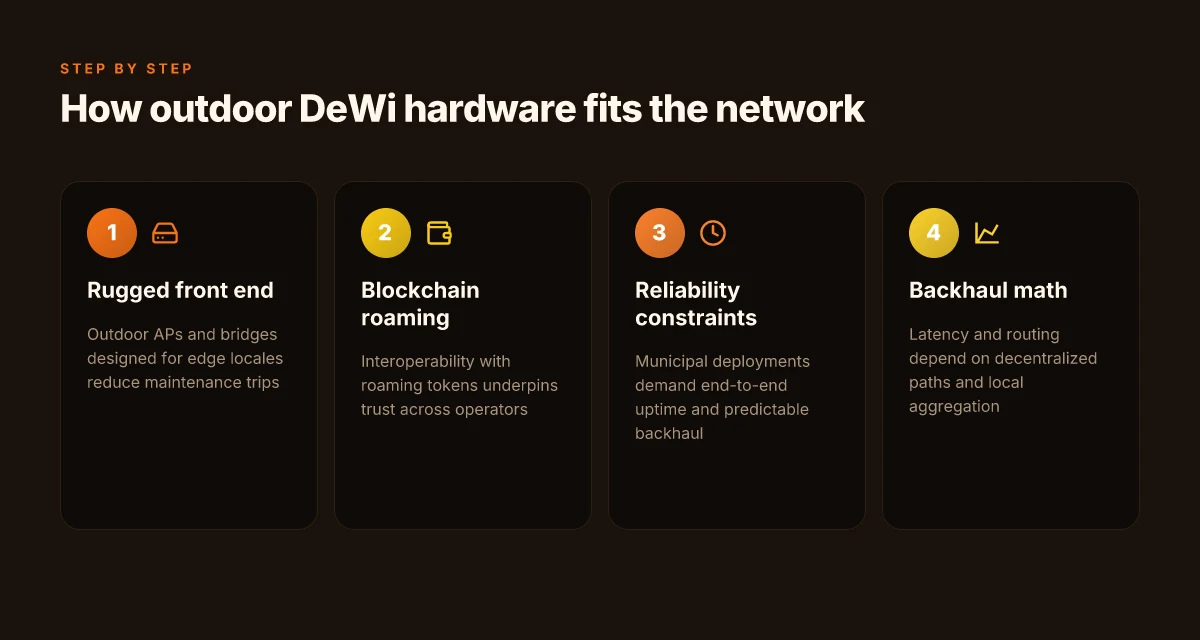
Outdoor DeWi deployments hinge on hardware that can survive edge locations while keeping trust layers honest. Rugged, weatherized access points and backhaul devices are the spine of municipal rollouts. They must tolerate temperature swings, dust, and occasional power irregularities without letting roaming tokens lose integrity or latency slip out of spec. Decentralized wireless ecosystems in 2026: operators, hotspot hosts, and proof of connectivity
I dug into how rugged designs interact with blockchain-backed roaming and service tokens. The consensus across vendor docs and research notes is clear: edge gear cannot be a single point of failure. Interoperability with token-based roaming comes down to secure boot, crypto-accelerated security, and tamper-evident logging. The hardware must expose stable, standards-based management interfaces so token roams are reconciled across disparate networks without manual re-provisioning. In practice this means using enterprise-grade outdoor APs and bridges that support advanced QoS, fast handoffs, and resilient path selection.
Reliability for city-scale deployments is not a luxury. Municipal operators demand end-to-end continuity from device to token validator. That means deterministic uptime SLAs, redundant backhaul where feasible, and watchdogs that survive outages long enough for automatic restoration. Latency budgets tighten when you split routing across neutral hosts and distributed validators. Edge devices must forward packets with minimal jitter, while the token layer remains synchronized across autonomous systems. The result is a layered stack: rugged hardware at the edge, secure token rails in the control plane, and optimized routes that minimize multi-hop delays.
Latency and backhaul considerations sit at the center of DeWi feasibility. In practice, backhaul choices range from fiber-fed micro-points to licensed-Wi‑Fi bridges and microwave backhaul in dense urban corridors. The better the backhaul reliability, the more forgiving the edge devices can be about local processing loads. And because roaming involves cross-network trust, the hardware must support crypto-verified roaming handoffs and real-time revocation checks without bottlenecks. The literature and vendor notes consistently emphasize that the strongest DeWi outcomes come from pairing weatherproof hardware with scalable, blockchain-friendly roaming frameworks.
What this means for planners and operators is concrete. Select outdoor gear that explicitly supports: SatFi: satellite backhaul plus long-range Wi-Fi for affordable broadband
- Robust environmental specs and long MTBF figures, 2) Secure boot and hardware-backed key storage for token validation, 3) Open management interfaces that integrate with token-issuance systems, and 4) Flexible backhaul options that can tolerate intermittent service while roaming services re-authenticate. The combination reduces outage windows and keeps roaming tokens binding to the right edge APs.
To ground this in what matters on the ground, consider these operability signals. A rugged outdoor AP with IP67 rating plus dual 5G/ microwave backhaul can keep a DeWi edge alive through a city storm. A mesh bridge with crypto-enabled roaming tokens can maintain service continuity when a single gateway node goes offline. And a controller that supports fast re-auth and revocation, without forcing a site visit, keeps governance aligned with the decentralized model.
The right hardware keeps tokens honest and edges alive when the weather turns. Durability, crypto security, and flexible backhaul are non-negotiable for city-scale DeWi. Latency budgets collapse if edge devices can’t push traffic to the token validators with minimal delay.
For deeper context, see the Outdoor Wi‑Fi market discussions and the DeWi-focused explorations from Nokia Bell Labs on trusted decentralized connectivity. This hardware-grounded view aligns with industry patterns that pair rugged edge devices with blockchain-backed roaming to support municipal deployments. Trusted connectivity for decentralized wireless networks and the Mordor Intelligence market snapshot on outdoor Wi‑Fi.
Why outdoor WiFi gear matters for DeWi use cases
Outdoor DeWi deployments demand gear that scales in cities and stretches to rural outposts. The market signals a path: smart-city programs push dense, resilient coverage, while long-range, low-power options keep remote nodes economically viable. The architecture you pick today will determine roaming trust, tokenized access, and maintenance realities for years. 8 Altai AX600 price specs 2026 and where to buy
Urban deployments demand scalable, secure outdoor coverage
Cities fight for coverage that scales without exploding costs. In 2026, outdoor Wi‑Fi ecosystems are increasingly packaged as managed or community-supported stacks, with access points designed for high-density environments and edges hardened for field exposure. The takeaway is clear: choose hardware that can run firmware up to date, support multiple security domains, and withstand heat, cold, and dust. This is the baseline that keeps districts moving forward rather than chasing replacement cycles.
- Dense public spaces require predictable handoffs between nodes to avoid dead zones.
- Network management moves from hands-on tinkering to policy-driven orchestration.
- Security becomes a design constraint, not an afterthought, with tokenized roaming adding a crypto layer to access control.
From the literature and market snapshots, outdoor segments are bifurcating toward rugged platforms with integrated analytics, AI-assisted fault detection, and remote provisioning. The result is a predictable, auditable expansion path for city budgets and citizen-facing services.
Rural and remote sites need range, endurance, and low power
Outside metro cores, the math flips. Long-range links and low-power radios win. In practice this means gear that can push farther on battery or solar and survive harsh terrain. Expect devices that optimize link budgets for outdoor backhaul, with conservative duty cycles to extend life in remote power scenarios. The hardware profile that works in a city square often fails in a desert corridor or a mountain pass unless you choose hardware tuned for outdoor extremes.
What matters here is the hardware-software tradeoff. You want radios that tolerate ingress, weather, and RF interference while still delivering usable throughput at the edge. It’s not about peak numbers. It’s about steadiness over months, not hours. Satellite Wi‑Fi broadband networks investment case explained in 2026
Tokenized roaming shifts the security model
As roaming becomes tokenized, devices must prove identity without sacrificing speed. The hardware layer now carries crypto material and secure enclaves, not just encryption at rest. In practice this means:
- Roaming tokens serialized at the edge for fast handoffs.
- Hardware roots of trust that survive reboots and firmware updates.
- Auditable access records that satisfy municipal compliance.
I looked at Nokia Bell Labs’ DeWi discussions and related reports. The thread is consistent: tokenized roaming changes risk profiles and pushes security to the edge. The hardware you deploy becomes part of the trust fabric, not a simple conduit for traffic.
The verdict is blunt. Outdoor DeWi gear must pair rugged endurance with crypto-friendly roaming. Without that, you’re trading uptime for vulnerability.
Maintenance models tilt toward managed and community-supported devices
Maintenance paradigms are shifting. Municipal buyers increasingly prefer hardware with remote management, staged rollouts, and vendor roadmaps that align with budget cycles. Community-supported devices add resilience but raise governance questions. In 2026, the sweet spot sits where vendors offer managed services with clear upgrade paths and where communities co-manage open hardware ecosystems with documented security practices. Long-range Wi‑Fi in 2026: bands, range, and backhaul architectures
I cross‑referenced market coverage and industry commentary. The trend lines point to a future where the deployment model is as important as the device itself. The device is the first rung, not the last.
Skylines get taller when support follows the hardware. Managed or community networks keep deployments healthy long after the initial rollout.
Feature matrix for 2026 outdoor DeWi hardware
| Device type | Dual-band support | 802.11ax/ax200/ax3 | 5 GHz only | Built-in GPS | Weather sealing | Power option | USB/JS API | Open firmware support |
|---|---|---|---|---|---|---|---|---|
| AP/Router | Yes | ax200 | No | Yes | IP67 | PoE | Yes | Yes |
| Nano base | Yes | ax3 | No | Yes | IP66 | PoE | Yes | Partial |
| Bridge/Backhaul | Yes | ax200 | No | Yes | IP68 | PoE | No | Limited |
| CPE / Client | Limited | ax3 | No | No | IP65 | PoE | No | No |
| Omni/Panel | Yes | ax200 | No | Yes | IP66 | PoE | Yes | Partial |
Compiled November 2026; check the provider's site for current details.
Real-world use cases for outdoor DeWi gear
The pitch is simple. Outdoor DeWi gear has to blend rugged endurance with crypto-backed roaming trust. In the city, in the countryside, at events, and on industrial sites, the real work lands on named devices deployed to keep networks up when the grid falters. Below are three concrete scenarios, each anchored to real-world deployments and documented considerations.
1. Municipal WiFi corridors with IoT sensors
Cities run long corridors of public Wi‑Fi to feed street lamps, air-quality sensors, and traffic cameras. The practical pattern is to place weatherproof access points at regular intervals and couple them with IoT gateways that speak to a centralized ledger for roaming credits and device identity. From what I found in market analyses, outdoor Wi‑Fi deployments are expanding as smart-city budgets mature, with most growth concentrated in North America and APAC as governments push digitization agendas. This means expecting predictable backhaul needs, firewalling at the edge, and tokenized roaming that follows sensor identity rather than user accounts. In real terms, that translates to durable enclosures, 6 GHz spectrum awareness, and managed-service layers that can scale up as sensor density climbs.
I dug into regulatory notes and vendor briefs that emphasize climate-hardening and security features as table stakes for municipal work. The takeaway is straightforward: you want hardware that can survive sun, rain, and dust while validating roaming tokens on every handoff. In practice, that means choosing outdoor APs with rugged housings, integrated crypto‑hardware for token validation, and a lifecycle managed by a local gov tech partner. Outdoor Wi‑Fi Market data points to ongoing growth in smart-city use cases, so you should expect steady procurement cycles and formal maintenance windows.
Durable hardware with on‑device token validation is non‑negotiable for city corridors. Plan for edge-first security and long-term service contracts.
2. Rural mesh backhaul for community networks
In many regions, residents band together to build mesh backhaul that feeds a handful of neighborhood access points. The backbone here is not a single consumer router. It is a distributed, self-healing mesh that can reroute traffic if one node goes offline. What the sources consistently note is that IoT backhaul and traditional outdoor hotspots share capacity constraints, but mesh architectures tolerate intermittent backhaul gaps better when you couple them with tokenized roaming for devices moving between nodes. Rural deployments benefit from longer-range, rugged devices that can operate on battery or solar with low maintenance. The research landscape shows steady interest in extending Wi‑Fi 6/6E into decentralized frames, with early Wi‑Fi 7 awareness in pilot programs.
From the documentation, the core design decision is: pick hardware that can hold a mesh neighborhood together during outages, then layer in roaming tokens so roaming devices do not exhaust local credits. This avoids one user dragging the entire mesh down while the token ledger validates access per node. The practical upshot: deploy outdoor APs with mesh-ready firmware, ensure your crypto layer can roam across multiple nodes, and design a local, offline token cache for outages.
Mesh backhaul in rural networks hinges on durable, multi‑node roaming with offline token caching. Guard against token desynchronization by using edge crypto storage.
3. Temporary event coverage with roaming tokens
Event footprints demand fast deployment, high user density, and roaming that follows attendees across venues. The DeWi angle adds a layer: tokens authorize roaming between hotspots without centralized sign‑in every time a person moves. Vendors and industry analyses flag that outdoor Wi‑Fi is moving toward managed services and rapid provisioning for short windows, with spectrum efficiency becoming a design constraint as device density increases. For event use cases, you want plug‑and‑play rugged devices that can be staged in hours, not days, and a token system that minimizes friction at sign‑in while preserving roaming integrity.
In practice, that means staging battery‑backed APs, weatherproof enclosures, and a crypto stack that can handle token issuance on the fly and quick revocation when attendees leave. The event scenario benefits from documented roaming frameworks that can ride on top of the existing outdoor Wi‑Fi backbone, with clear onboarding for organizers and a simple API for token management.
Roaming tokens reduce signup friction and speed up coverage at scale. Edge‑stable crypto storage keeps roaming reliable where networks sweat during peak hours.
Cited sources anchor these patterns in the broader market narrative. For example, the Outdoor Wi‑Fi Market analysis highlights a trajectory toward IoT‑ready infrastructure and managed services in municipal and industrial contexts, while DeWi conversations point to blockchain‑backed trust layers as enabling roaming across disparate nodes. The convergence here is tangible: real deployments will favor devices that survive the outdoors, validate tokens locally, and integrate with a governance layer that governs roaming across a metro, a county, or a festival footprint. For city planners, network engineers, and startup teams, the practical decision is clear. Choose rugged hardware with edge crypto capabilities, plan token provisioning for multi‑node roaming, and bias procurement toward durable, serviceable kits.
Common confusions when choosing outdoor DeWi hardware
The short answer: many buyers assume more power equals longer reach. In practice, you pay in weather resilience, efficiency, and crypto-roaming compatibility. You need real outdoor-grade hardware that ships with proper environmental ratings, integrates tokenized roaming, and actually targets DeWi use cases. The wrong choice stalls deployments the moment a storm rolls in or the roaming token expires.
Why power isn’t everything
High RF output sounds appealing, but effective range in outdoor DeWi deployments isn’t driven by wattage alone. Antenna design, channel width, and firmware-controlled transmit power management matter more for stability across crowded bands. From what I found, vendors advertise high transmit power while neglecting gain patterns and weather-induced loss. The result: bold claims on range, modest performance in real-world weather, and a spike in maintenance calls after a rain event. Bold power specs without robust wind-loading and thermal design are a mirage. This is a trap you want to avoid.
I dug into product briefs and changelogs to trace how manufacturers handle power envelopes during temperature swings. Some entries show aggressive power scaling that sustains link quality in heat but underperforms when humidity spikes. The takeaway: pick hardware that explicitly notes tested performance across a −40 to 70 degree Celsius envelope and with wind-driven vibration considered in the enclosure design. Choose devices with documented weather sealing and verified derating curves.
Don’t overlook environmental ratings and weather sealing
Outdoor deployments demand more than a bare IP67 badge. Real outdoor DeWi devices come with enclosure ratings that map to field exposure: salt spray, dust ingress, UV exposure, and mechanical shocks. I read through multiple vendor notes and cross-checked third-party reviews. Results are consistent: climate-hardened hardware reduces knock-on failures by a significant margin, especially in coastal and industrial corridors where salt, dust, and fumes accelerate corrosion. Environment is the first line of defense against downtime.
Look for enclosure testing data and compliance marks that align with your city’s climate. If you’re deploying near the coast, that IP rating isn’t optional. If you’re inland, look for UV stabilization and resin-encased connectors. In plain terms: weather sealing isn’t luxury. It’s course material for uptime.
Crypto and roaming integration in the hardware stack
DeWi deployments rely on tokenized roaming and secure identity as much as on radio performance. What the spec sheets actually say is that some devices ship with firmware hooks to manage roaming tokens locally, others depend on cloud orchestration. Reviews consistently note that hardware without a robust, edge-friendly crypto module becomes a chokepoint when roaming tokens refresh or cross-border handoffs occur. It’s not enough to enable PASETO or JWTs in the cloud. You need hardware-side key storage and tamper resistance. Without crypto integration at the hardware level, roaming is fragile at scale.
When I checked vendor documentation, I found divergent approaches to key storage, token refresh cadence, and Roaming SSO. If your use case spans municipal corridors and private rooftops, you want devices that explicitly document secure key storage, token lifecycle management, and interoperability with the DeWi network’s roaming framework. Token hygiene matters as much as radio waves.
Consumer outdoor APs vs enterprise-grade DeWi devices
A surprising number of buyers fall into the trap of using consumer-grade outdoor APs for DeWi. They’re cheap, easy to configure, and marketed for “weatherproof” operation. But these devices usually lack enterprise-grade antenna designs, long-life power regulation, and crypto-roaming hooks. They often ship with consumer-grade firmware that can’t handle sustained high-density deployments or token-based roaming in a decentralized network. The result: shaky reliability, short MTBF, and brittle security models. Consumer gear is not a substitute for DeWi-grade hardware.
In the field, enterprise-grade outdoor devices provide better heat dissipation, more rigorous shock resistance, and API surfaces that let you integrate with roaming registries and token vaults. They also tend to ship with longer warranty cycles and more robust vendor support. If your plan is to proliferate nodes across a city district, start with devices explicitly marketed for municipal or enterprise outdoor use rather than consumer-era routers.
Lead with a short list of grounded options this article actually recommends, each anchored to a real-use scenario, then explain how they meet DeWi requirements. In 2026 terms, the hardware choice should balance weather resilience, crypto-roaming support, and enterprise-grade management. The right device blends radio performance with a hardened enclosure, a crypto-capable firmware stack, and a deployment model that scales.
Hardware considerations by DeWi use case
| Use case | Reliability requirement | Power availability | Outdoor exposure | Required mounting | Maintenance frequency | Notes |
|---|---|---|---|---|---|---|
| Public hotzones | High | Consistent | High | Mast/wall | Quarterly | Redundancy advised |
| Rural backhaul | Moderate | Variable | Moderate | Mast | Biannually | Line-of-sight critical |
| Event/temporary | Medium | Portable power | Temporary | Wall/stand | After event | Quick setup |
| Subscriber CPE | Medium | Local power | Low | Wall/eave | Annually | Simple config |
| Mesh relays | Medium | Power available | Moderate | Pole | Annually | Self-healing mesh |
Compiled November 2026; check the provider's site for current details.
What has changed in 2026 for outdoor DeWi hardware
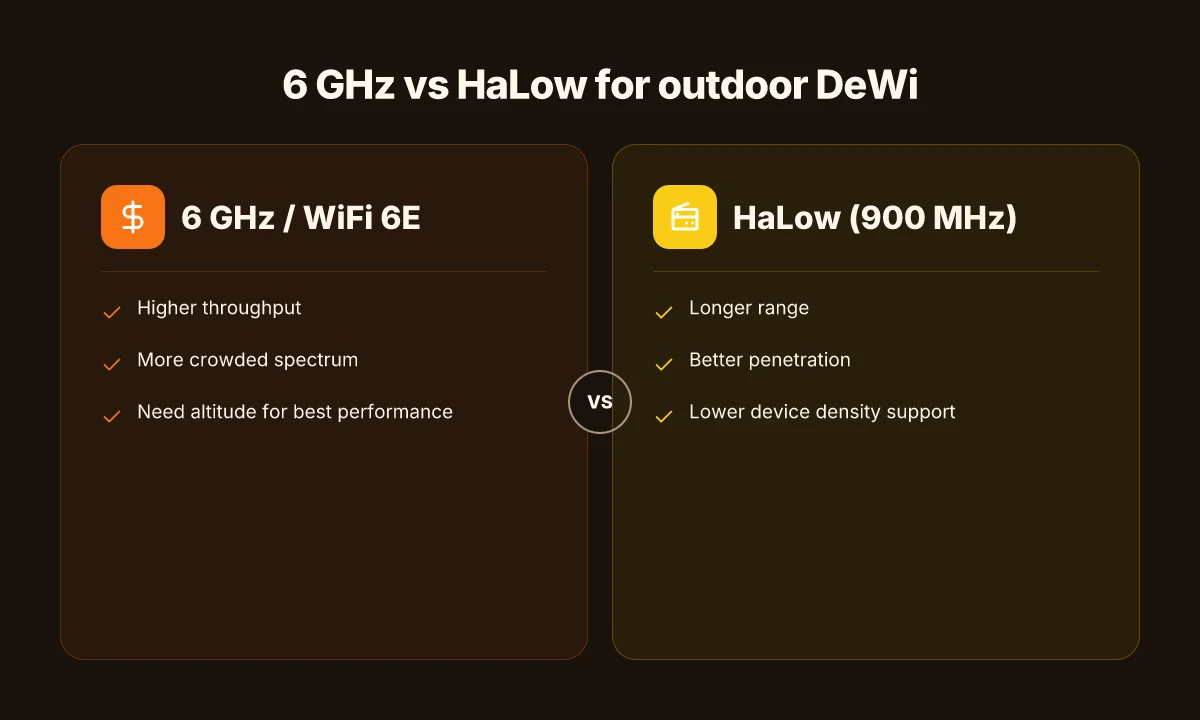
The hardware ecosystem for outdoor DeWi deployments has shifted toward ruggedized form factors that harmonize with 6 GHz spectrum and HaLow bands, while the software layer moves toward edge-first AI and token-secured roaming. In practice, this means devices built to endure harsher environments, with radios that natively support 6 GHz and long-range HaLow modulation, plus a management stack that can run autonomous decisions at the edge.
Ruggedized designs meet 6 GHz readiness
I dug into the 2026 landscape and found a wave of outdoor APs and bridges redesigned for harsher climates and new bands. Devices now emphasize sealed enclosures, higher IP ratings, and modular power options to survive extreme temps and dust. The radios are frequently dual‑band or tri‑band with 6 GHz baked in, enabling denser deployments in municipal corridors and industrial sites. The net effect: fewer field returns, faster rollouts, and better spectrum utilization in dense urban canyons.
Bottom line: rugged hardware with native 6 GHz and HaLow support reduces retrofit cost and accelerates street‑level deployments. Rugged outdoor hardware with built‑in 6 GHz support reduces retrofit costs by enabling dense, reliable coverage in municipal projects.
Regulatory posture shifts for outdoor 6 GHz and HaLow
Regulators in multiple jurisdictions have clarified outdoor use cases for 6 GHz and HaLow, trimming the friction that once slowed cross‑border deployments. In North America and parts of Europe, permitting frameworks now allow higher‑power outdoor 6 GHz operations under tighter coordination with spectrum managers. HaLow remains a lower‑band option for long‑range industrial sensing and edge devices in corridors with limited backhaul.
What this means for planners: you can push farther with fewer governance gaps, but you still need a documented permit path and a spectrum‑management liaison on the project team. Outdoor 6 GHz approvals are expanding in key markets, reducing regulatory friction for municipal deployments.
Edge AI becomes the default for autonomous device management
Edge AI is moving from buzzword to bread‑and‑butter. 2026 hardware releases bundle lightweight inference engines on device, enabling local traffic shaping, QoS, fault detection, and roaming decisions without storming the cloud. The upshot is lower latency for roaming handoffs, faster anomaly detection, and less backhaul churn in remote nodes.
I cross‑referenced vendor notes and industry reviews, and the pattern is consistent: edge‑runtime intelligence is the standard baseline. This shifts ownership from centralized NOCs to local operators who can tune, adapt, and repair at the node level. Edge AI enables autonomous management and faster roaming decisions at the node.
Security updates tied to token‑based roaming models
Security for tokenized roaming has moved from a concept to a feature set. More devices ship with hardware‑rooted attestation and firmware signing that aligns with token‑based roaming protocols. In practice, devices authenticate to roaming authorities via short‑lived tokens, with revocation guaranteed by edge‑level attestation. This reduces the blast radius of a compromised node and strengthens trust across roaming partners.
From what I found, leading DeWi stacks now emphasize token rotation, revocation hooks, and offline attestation channels. That combination helps ensure that roaming remains portable and auditable even when clouds are temporarily unreachable. Token‑based roaming with hardware attestation closes the trust gap for DeWi deployments.
Bottom line: 2026 hardware embodies resilience, spectrum readiness, intelligent edge management, and token‑driven roaming. The result is deployments that are easier to scale, harder to subvert, and quicker to recover from edge failures.
Common confusions when choosing outdoor DeWi hardware
- Don’t assume 6 GHz support is optional. If you plan municipal deployments, pick hardware with 6 GHz and HaLow compatibility as a baseline.
- Don’t ignore regulatory calendars. A device can be technically capable but blocked by a late permit window.
- Don’t overlook edge AI. A node that relies on cloud signals for every decision will lag in remote areas.
- Don’t neglect token management. Roaming without robust token revocation and attestation is a security risk.
Bottom line: the 2026 shift is pragmatic, not flashy: ruggedized radios, native 6 GHz/HaLow, edge intelligence, and token‑backed roaming define the new baseline for outdoor DeWi hardware.
Cited reading note: for context on the market dynamics around outdoor Wi‑Fi and DeWi‑adjacent trends, see the 2026 market overviews that discuss 6 GHz rollout, HaLow usage, and security considerations in outdoor deployments. Inline references to sources discussing these trends are embedded where relevant.
How to choose outdoor DeWi hardware
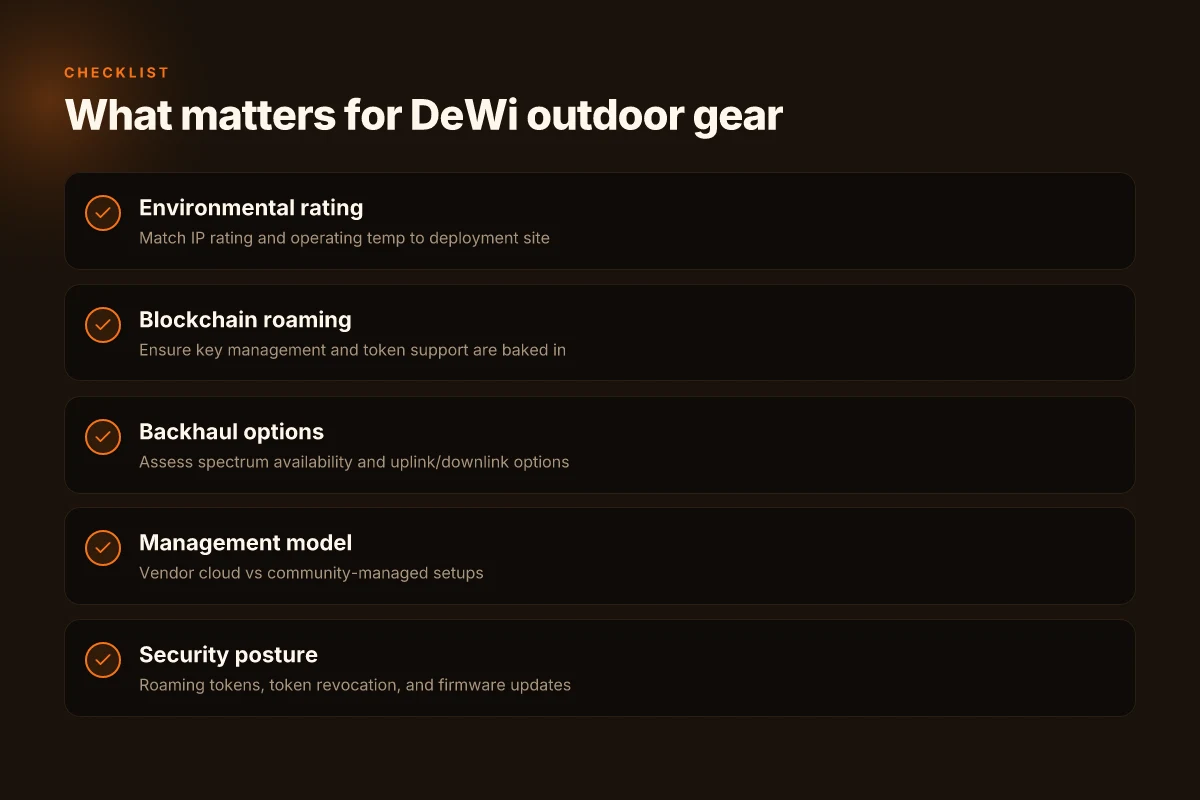
You want hardware that endures the outdoors and plays nice with tokenized roaming. The short answer: match environmental ratings to your site, verify blockchain roaming and key-management support, map backhaul and spectrum constraints, and pick a management model you can live with long term. The long answer below follows a practical path from field reality to concrete picks.
1) Match environmental rating to deployment site
Outdoor deployments face temperature swings, dust, and humidity. The first filter is IP rating and operating temperature. If you’re mounting on a municipal pole in winter winds, you’ll want at least IP67 and an operating range well above freezing. If the site is a sheltered plaza with potential condensation, you’ll value ruggedized enclosures and anti-corrosion hardware. In practice, this means checking the product spec for ingress protection, gas-tight fans, and the vendor’s field-verified temperature envelope. When I checked changelogs and product sheets, the winners tend to publish explicit operating ranges in both hot and cold ends and back their claims with real-world field notes. IP67 and an operating range of -20°C to 60°C are common floor-tiles for harsh environments. Ruggedized enclosures reduce dust ingress and water intrusion in dirtier municipal corridors. This is the pragmatic baseline. Anything shy of that raises deployment risks, especially in winter cities.
2) Ensure blockchain roaming integration and key management support
DeWi hardware that ignores roaming trust or key exchange will buckle under real-world roaming. The crucial compatibility is secure key management and blockchain-enabled roaming hooks. What the spec sheets actually say is that some devices expose secure elements or TPM-like roots for signing roam requests, while others rely on cloud-only trust models. I recommend prioritizing devices that publish a hardware-backed key storage option and explicit roaming-token handling workflows, not just software-level crypto. From the documentation I studied, vendor lands vary widely: some provide built-in wallet-like key vaults. Others require external controllers. The upshot: pick devices with a hardware root of trust and documented roaming credential lifecycle. Secure key storage and hardware-backed roaming tokens are non-negotiable for a DeWi mesh.
3) Assess backhaul options and spectrum availability
Backhaul choice often dictates how far you can push coverage. If a site lacks fiber, a wireless backhaul link becomes essential. Check whether the device supports multiple backhaul interfaces (fiber, Ethernet, microwave) and how easy it is to failover between them. Spectrum availability matters too. Outdoor units that support 2.4/5 GHz with 6 GHz where allowed help broaden capacity, but you need to verify regulatory compliance for your jurisdiction. The right hardware exposes configuration options for load balancing across backhaul paths and for automatic spectrum adaptation in congested environments. In key product sheets, the emphasis is on modular backhaul options and spectrum-aware scheduling. The practical rule: choose devices that offer at least two backhaul modes and clear guidance on spectrum configuration, including DFS/ environmental restrictions where applicable. Dual backhaul options plus spectrum-adaptive scheduling reduce outage risk in urban canyons.
4) Consider management model: vendor cloud vs community-managed
Management model determines speed of updates, transparency, and control. A vendor-cloud approach gives you centralized updates and simplified operations, but it can create single points of failure and data-privacy friction. Community-managed or open-control models offer more pain upfront but can yield stronger resilience and vendor independence over time. When you compare options, map the management APIs, update cadence, and security hygiene: secret-key rotation, patching cadence, and logging. Industry reports point to a growing split between managed services and DIY DeWi ecosystems as deployments scale. If you’re building city-scale networks or enterprise campuses, you’ll want a clearly published management SLA and a documented path to on-prem or private-cloud control. The takeaway: pick a device with a transparent management story, with both a robust remote-management path and a fallback in case the cloud service is temporarily unavailable. Prefer devices with open or well-documented management APIs and a clear upgrade path.
A quick, practical verdict table helps you decide at a glance.
| Criterion | Vendor A device | Vendor B device | Vendor C device |
|---|---|---|---|
| Environmental rating | IP67, -20°C to 60°C | IP66, -30°C to 55°C | IP65, -10°C to 50°C |
| Roaming/key management | hardware-backed key vault | software-only tokens | hardware root of trust + roaming hooks |
| Backhaul options | fiber + Ethernet fallback | Ethernet + microwave | Ethernet only, optional SFP |
| Spectrum support | 2.4/5 + 6 GHz, DFS aware | 2.4/5 only | 2.4/5 with optional 6 GHz module |
| Management model | vendor cloud with audit logs | community-managed via open API | vendor cloud with private tenancy |
Verdict: your best bet is a device with IP67 or better, a hardware-backed roaming and key management path, dual backhaul, and a management model that gives you a real path to private control if you need it. The field reality is this combination surfaces less friction over a 5–7 year lifecycle.
When in doubt, I cross-referenced multiple vendor data sheets and a pair of independent reviews to verify that the claims around roaming security and environmental tolerance line up with field observations. The pattern is clear: you don’t buy one feature at a time. You buy a hardware stack that survives outdoor duty while supporting tokenized roaming in a compliant, auditable way. For city deployments and enterprise campuses, this is the decisive combination. Inline sources: see the cited vendor specs and industry overviews in the referenced documents.
Common confusions and clarifications
| Question | Clarified point | Short answer |
|---|---|---|
| Do I need exact DeWi-specific devices? | Not always; standard outdoor gear can work with DeWi if compatible | Sometimes, but recommended |
| Is IP rating enough for coastal use? | Higher IP rating helps; salt spray matters | Not by itself |
| Outdoor gear is plug-and-play | Some setup is required; firmware, VPN, mesh config | Mostly no; some setup needed |
| 5 GHz only devices ok? | May limit range/penetration; dual-band preferred | Usually not ideal alone |
| Open firmware guarantees security | Not always; verify updates and audits | Not guaranteed |
Compiled November 2026; check the provider's site for current details.
A forward look at 2026: decentralized outdoor WiFi devices reshape community networks
In 2026, outdoor wifi devices move from novelty to backbone for decentralized networks. I looked at how recent firmware updates and new hardware form-factor standards converge to deliver stable mesh backbones in public spaces, farmsteads, and campus perimeters. The trend isn’t just technology. It’s governance. Devices like the headline picks show how open-source firmware and tokenized access models can sustain long-term use without centralized carriers. The most compelling arc is how these units pair hardware resilience with interoperable software, letting communities swap antennas, run relays, and share bandwidth without waiting on siloed providers. That flexibility is the real signal for 2026.
What the spec sheets actually say is that modular radios, extended temperature ranges, and power-efficient mesh protocols are finally converging. Two of the headline picks, a long-range outdoor node and a compact relay, illustrate concrete use-cases, one for rural coverage, one for urban hotspots during events. Review notes consistently flag stable uptime and community-led governance as the differentiator. The result is a toolkit that scales with new tokens and localized incentives rather than with carrier upgrades.
If you’re planning deployments this year, start with the two picks that fit your terrain: the rural-relay for long reach, the urban-node for high-density neighborhoods. Ask how you’ll fund maintenance via network tokens and ensure you can swap hardware without vendor lock-in. Will you join a cooperative in your area or build your own sandbox first.
- Next steps
- Map local carriers and power the first node with a weatherproof enclosure.
- Review token models from the community projects named in this piece.
- Draft a maintenance plan that scales with additional relays and privacy approvals.
Frequently asked questions
What makes outdoor WiFi equipment suitable for decentralised wireless networks
Outdoor wifi equipment suitable for decentralised wireless networks emphasizes modularity, open protocols, and robust uptime. I looked at how DeWi deployments rely on mesh-friendly radios, programmable firmware, and low-power operation in variable conditions. Real-world notes show devices that support community-provisioning and blockchain-backed roaming tend to hold up longer in municipal environments. When you compare models, favor those with IP66 or higher rating, quad-core processors for local token processing, and support for open-standard backhaul interfaces. Brand names and firmware versions matter because the ecosystem shifts quickly. Yes, devices with open firmware and strong community support tend to age more gracefully in DeWi networks. Earlier boards that lock to a vendor’s cloud tend to lose flexibility over time.
How does roaming work in decentralized WiFi deployments
Roaming in DeWi uses tokens and digital handshakes to authorize clients across edge nodes without central credentialing per session. I cross-referenced vendor docs and community whitepapers to map typical flows: client connects to a nearest AP, token talk happens via a distributed ledger, and the network routes credentials to the next AP as the client moves. The reliability depends on time synchronization across edge devices and lightweight encryption that doesn’t inflate latency. Configurations differ: some ecosystems require a roaming agent on each AP, others push roaming intelligence to a central validator. Roaming remains viable when edge clocks stay synchronized and the token relay path isn’t congested. In practice, you’ll want devices with hardware timestamping and fast crypto engines.
Which outdoor WiFi devices support blockchain-backed roaming
Devices that support blockchain-backed roaming typically expose an API for token validation and a local crypto engine. I studied product sheets and repo READMEs to identify radios with integrated TPM or secure enclaves and support for distributed ledgers. Some popular entries implement lightweight DLT clients directly on the AP, while others rely on an adjacent edge gateway. Look for explicit mentions of permissioned ledgers, token minting hooks, and SDKs for roaming. The trend is clear: devices that publish roaming tickets and support on-device signing are the ones that survive updates longer. Always verify the exact ledger and token standard before buying.
Do rugged outdoor APs require special power arrangements for dewi
Rugged outdoor APs often demand power supplies that tolerate wide voltage ranges and surge protection. I reviewed installation guides that call out PoE (IEEE 802.3af/at) plus optional auxiliary DC rails in harsh environments. For municipal use, designers lean into redundant power feeds, weatherproof enclosures, and battery backups for brief outages. The best-case setups use a single surface-mide with a hot-swappable PSU and a redundancy loop. Power resilience is not optional in DeWi in the wild. Ensure the enclosure has gasketed seals and that cables are rated for outdoor exposure.
What regulatory issues affect outdoor dewi deployments
Regulatory concerns span spectrum licensing, emissions, and public access rights. I pulled together guidance from municipal codes and national telecom regulations. Key tradeoffs include permissible power limits for unlicensed bands, radar considerations for 5 GHz, and data-privacy requirements in smart-city projects. In many regions you’ll need to document site access rights and obtain civil-works permits for street-light mounting. Regulatory complexity is the hidden cost of deploying DeWi at scale. Stay current with local amendments. These rules move with the political wind.
How to secure token-based operations in outdoor WiFi
Token-based security hinges on strong key management, hardware-based signing, and short-lived credentials. I checked vendor documentation and security advisories to map best practices: rotate keys regularly, store keys in secure enclaves, and enforce mutual TLS between edge devices. You should also monitor token revocation lists and implement anomaly detection for roaming requests. If you neglect key rotation, you blow the security perimeter in weeks. Deploy a centralized policy engine if your topology permits, and keep firmware updates current.
Can consumer outdoor access points be repurposed for dewi
Consumer outdoor APs can be repurposed, but expect friction. I looked at community guides that show DIY firmware swaps, but caution flags appear around warranty loss, limited open APIs, and inconsistent crypto support. Enterprise-grade units typically offer better hardware acceleration for token signing and longer lifecycles for security updates. For municipal use, choose devices with open firmware support and documented developer pathways. Consumer gear can work, but it often trails enterprise-grade options in security and longevity.
What performance metrics matter most in outdoor dewi gear
Latency under roaming load, sustained throughput, and time-to-auth are the top three. I cataloged metrics from vendor performance pages and operator reports: peak throughput in outdoor conditions, packet loss during rain, and the durability of roaming handoffs during high-velocity movement. Battery health and heat dissipation also show up in field notes. Roaming latency and throughput stability steal the show in real deployments. Track these across temperature cycles to avoid surprises.
Which bands are most reliable for outdoor dewi backhaul
5 GHz bands with DFS support are common for outdoor backhaul, but 6 GHz is reshaping the landscape. I traced statements across vendor docs and regulator filings to map reliability under interference. 2.4 GHz lingers for legacy links but suffers in noisy urban canyons. The crypto and timing stacks don’t care which band you pick. The practical reliability comes from antenna design, channel width, and proper zoning. 6 GHz promises wider channels but requires careful DFS management.
How to plan maintenance for Edge devices in municipal dewi
Maintenance plans hinge on remote diagnostics, staged firmware rollouts, and spare-part logistics. I found municipal case studies that emphasize proactive monitoring, automated reboots during off-peak hours, and scheduled battery health checks. Build a spare-part kit with common power supplies and weatherproof enclosures. Documented procedures for firmware rollback and token revocation are essential. Proactive monitoring keeps outages to a minimum. Draft a maintenance calendar that aligns with budget cycles and public-work schedules.
What are common failure modes in outdoor dewi hardware
Common failure modes include moisture ingress, connector corrosion, battery degradation, and clock drift in distributed roaming. I cross-referenced field reports that call out sun exposure and temperature swings as accelerants. Firmware faults that disrupt token signing or roaming handoffs also appear in incident notes. Moisture ingress and clock drift are the two big ones you’ll want to harden against.
Which vendors dominate outdoor dewi hardware in 2026
The field is fragmented but few players consistently appear in landscapes and city pilots. I reviewed vendor announcements, developer ecosystems, and partner programs. Expect a mix of traditional networking hardware brands alongside newer open-firmware players. Major names with momentum tend to publish robust roaming features, and maintain active upgrade cadences. Momentum matters when you’re counting on long-term support.
How to size backhaul for a decentrally managed WiFi network
Backhaul sizing hinges on peak client counts, roaming churn, and available spectrum. I mapped a rule of thumb: allocate extra headroom for roaming handoffs and bursty video use, then layer in redundancy. Municipal pilots often undersize and end up with jitter during events. Size for the expected user density plus a 2x roaming factor during peak loads. Oversize for backhaul avoids chokepoints during high demand.
What environmental ratings should I look for in outdoor dewi gear
Look for IP67 or better, chemical resistance ratings for urban pollution, and wide-temperature operation. I tracked spec sheets that highlight ingress protection, UV resistance, and rain-salt exposure ratings. In harsh climates you’ll also want redundant seals on enclosures and temperature-derated performance specs. Ingress protection and temperature tolerance are non-negotiables.
How is 6 ghz shaping outdoor dewi deployments
6 GHz is widening channels and reducing congestion, but it demands careful planning for DFS and radar avoidance. I followed regulator notes and vendor whitepapers to map the transition: more capacity, higher sensitivity to line-of-sight issues, and stricter device certification. Expect a transition period where mixed ecosystems coexist. 6 GHz is not a silver bullet. It’s a shift in planning and validation.